By Devin Jones January 19, 2026
Sustainable shopping in Montréal isn’t just a trend—it’s a practical way to save money, cut waste, and keep your spending aligned with your values.
This sustainable shopping Montreal guide is designed for real life: where to start, how to shop low-waste, how to find ethical fashion, and how to build a “reuse-first” routine that works even when you’re busy.
Montréal is especially well-suited to conscious choices because everyday infrastructure already supports it: strong public transit, walkable shopping streets, active second-hand culture, and a growing push toward a circular economy (repair, reuse, refill, and recycling).
The city has explicitly framed the circular economy as part of its ecological transition strategy, linking resource preservation with local economic growth.
This guide also includes Mount Royal as a reference point for planning a sustainable day out, because it’s one of the easiest “anchor locations” to connect multiple neighborhoods on foot or by short transit hops.
The main park is Parc du Mont-Royal, a large green space in the Ville-Marie area with well-known trails and access points (including Chemin Remembrance).
What “Sustainable Shopping” Means in Montréal Right Now
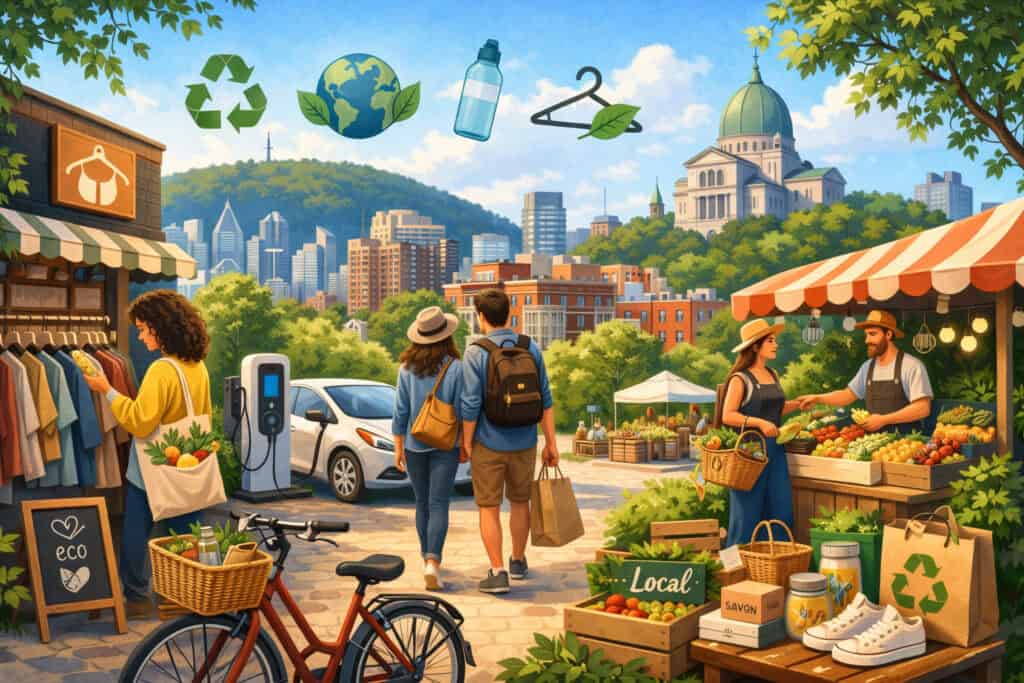
A modern sustainable shopping Montreal guide needs to go beyond “buy eco stuff.” In practice, sustainable shopping here usually means four things:
1) Buy less, choose better (and keep it longer)
The greenest purchase is often the one you don’t make. Montréal’s best sustainable habits start with durability: fewer items, higher quality, and a plan for maintenance (shoe repair, mending, tailoring).
This is where the local culture helps—second-hand is mainstream, repairs aren’t “weird,” and many neighborhoods have services close by.
2) Refill and bulk where it makes sense
Low-waste shopping is easier when refill and bulk are convenient. Bulk stores let you bring your own containers, reduce packaging, and control quantities (which can reduce food waste).
For example, Méga Vrac positions itself as a zero-waste ecological grocery offering a wide range of bulk products and encouraging customers to bring reusable containers.
3) Prioritize local and seasonal
Seasonal food shopping is a sustainability multiplier: shorter transport chains, fresher produce, and more support for local growers and makers. Montréal is known for public markets and specialty shops that make local sourcing feel normal instead of niche.
4) Keep materials in circulation (repair, reuse, recycle responsibly)
The city and local organizations increasingly emphasize circular economy thinking. That includes better textile collection and scaling recycling solutions. Renaissance, for instance, highlights the scale of textile waste in Montréal and discusses textile recycling efforts as part of extending material life cycles.
When you combine these four behaviors, sustainable shopping stops being a “special trip” and becomes your default.
Sustainable Shopping Montréal by Neighborhood: How to Choose Your Route
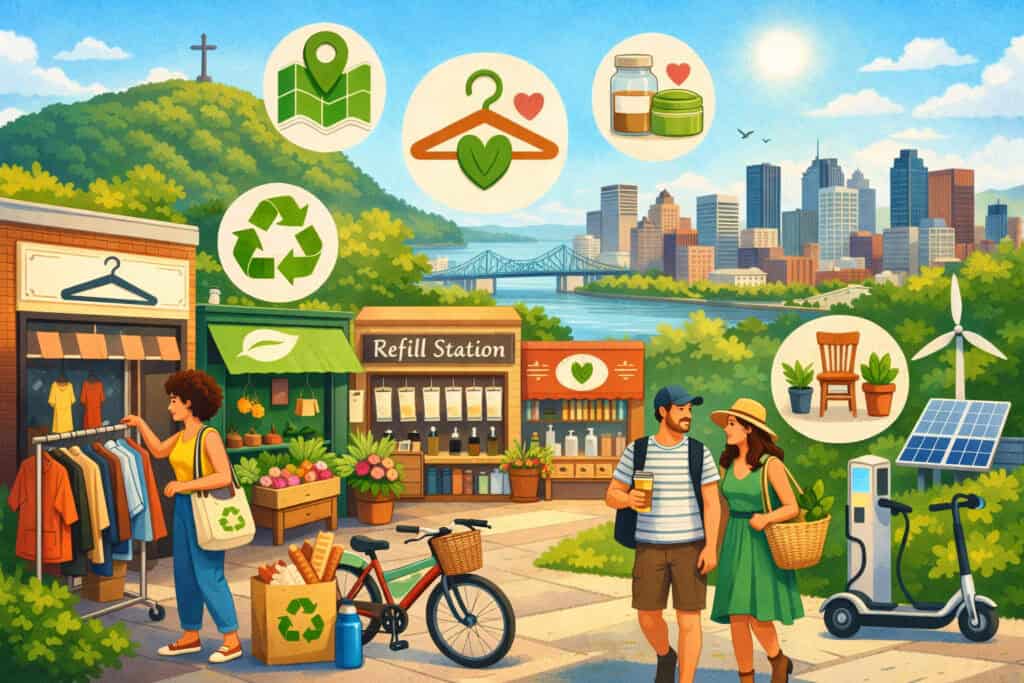
A strong sustainable shopping Montreal guide should help you plan geographically, because the easiest sustainable shopping is the kind you can do without a car and without backtracking all day.
Plateau–Mont-Royal and nearby streets: the “walk-and-browse” core
Plateau–Mont-Royal is often where people naturally build a sustainable routine: it’s dense, walkable, and packed with small shops that support second-hand culture, local makers, and specialty goods.
Even if you don’t buy, browsing here is useful for learning price ranges and styles so you make fewer impulse purchases later.
Mile End and adjacent areas: creative makers + resale culture
Mile End’s vibe pairs well with sustainable shopping because people look for unique pieces, not mass uniformity. This fuels resale demand and supports local crafts.
Central areas and market corridors: the food + essentials loop
For sustainable food shopping, you’ll often do better around market corridors and bulk-friendly stores. This is where you can combine: produce, pantry refills, and household staples in one trip—reducing errands and packaging at the same time.
Using Mount Royal as your “sustainable reset”
If you’re trying to avoid turning sustainable shopping into an exhausting marathon, use Mount Royal as a mid-day reset. Parc du Mont-Royal is a well-known green anchor with trails and activity status updates provided by the city, and it’s easy to reach from multiple directions.
A simple tactic: shop in the morning, walk up for a break, then finish with groceries or refills on the way home. You’ll make calmer decisions (and usually buy less).
Zero-Waste and Refill Shopping: How to Start Without Overcomplicating It
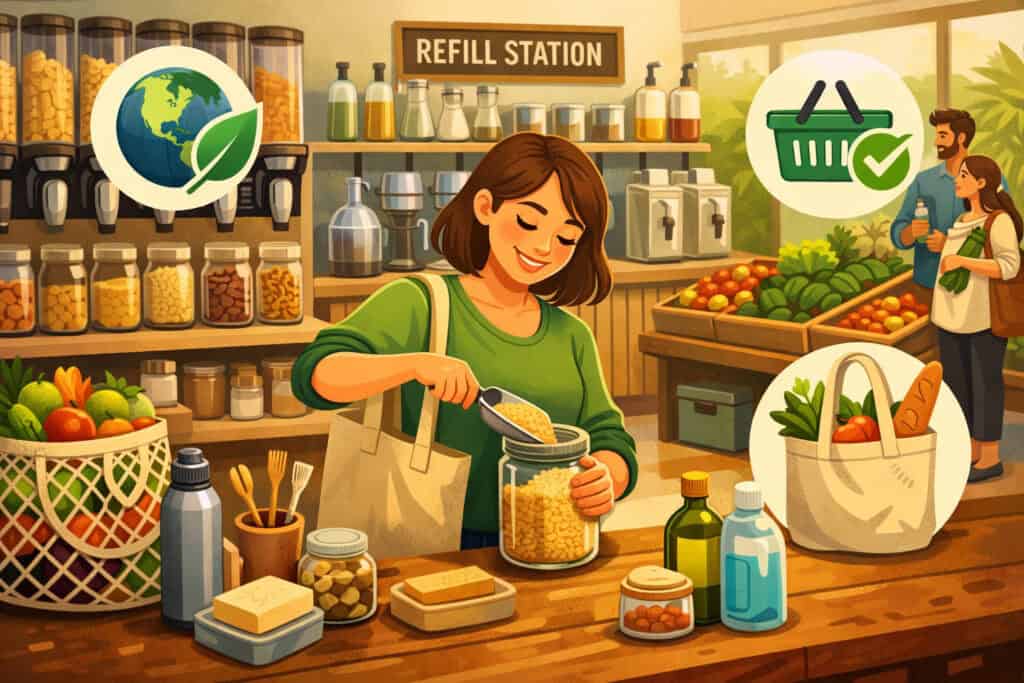
Refill culture can look intimidating online, but in real life it’s just a system. A practical sustainable shopping Montreal guide starts with one category at a time.
Start with pantry basics you already use weekly
Pick 5–10 staples you buy repeatedly: oats, rice, beans, pasta, coffee, spices, soap, dish detergent. Bulk shopping reduces packaging and lets you buy the amount you actually need, which can reduce waste and sometimes cost.
Méga Vrac is one example of a Montréal bulk/refill concept: it emphasizes a large selection of food and household products sold without packaging and encourages reusable containers.
Build a “container kit” that fits in your bag
You don’t need an Instagram-worthy jar collection. You need:
- 2–3 medium containers for pantry items
- 1 small container for spices/tea
- 1 produce bag (or reused bag)
- 1 bottle for liquids (if you refill soap/detergent)
Keep it simple so you actually repeat the habit.
Avoid the common refill mistakes
A sustainable shopping Montreal guide should warn you about friction points:
- Overbuying because bulk looks cheap (leads to food waste)
- Buying “new eco products” that duplicate what you already own
- Skipping labels (you still need ingredients/allergens tracked)
Refill works best when you’re replacing routine purchases, not adding new categories.
Sustainable Fashion in Montréal: Second-Hand First, Then Ethical New
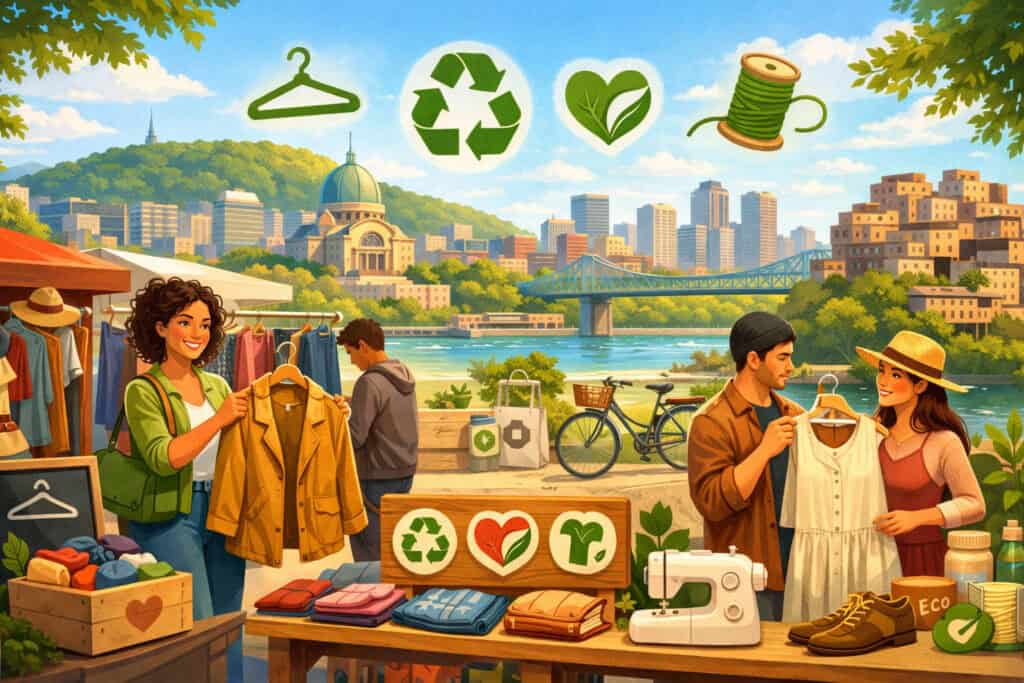
Fashion is where sustainable shopping can make the biggest impact fast—because clothing has high material, water, and transport footprints. The simplest rule for sustainable fashion in this sustainable shopping Montreal guide is:
Look second-hand first. Buy new only when you can’t find it used.
The sustainable fashion ladder
- Repair what you own (buttons, seams, hems, zippers)
- Buy second-hand (thrift, vintage, resale, consignment)
- Swap or borrow (events, community exchanges)
- Buy new—ethically (durable, transparent brands, natural or recycled materials)
Why second-hand works so well here
Local guides consistently frame Montréal as a strong city for vintage and thrift shopping, with options across different styles and budgets. Second-hand also aligns with the city’s broader circular economy direction—keeping items in use longer and reducing waste.
Making ethical new purchases smarter
When you do buy new, shop like a sustainability pro:
- Choose timeless cuts you’ll wear for years
- Prefer natural fibers (if you’ll care for them) or recycled fibers (if durability is proven)
- Ask: “Will I still want this next season?”
- Check care requirements—clothes that are hard to maintain often become short-lived
This approach keeps your wardrobe smaller, cheaper over time, and easier to manage.
Local Food Shopping: Markets, Seasonality, and Low-Waste Meals
A city-friendly sustainable shopping Montreal guide should treat food as the “daily sustainability lever,” because you shop for food often, and small changes compound.
Shop seasonal and build flexible meal templates
Instead of planning rigid recipes, use meal templates:
- Grain + roasted seasonal vegetables + sauce
- Big salad + protein + bread
- Soup/stew + leftovers for lunch
Seasonal buying makes this easier because the same ingredients appear across multiple meals.
Reduce food waste (the underrated sustainability win)
Food waste is expensive and avoidable. A few Montréal-friendly habits:
- Buy smaller quantities (bulk helps here)
- Freeze leftovers intentionally
- Store produce correctly
- Keep a “use-first shelf” in your fridge
Combine food sustainability with walkability
If your shopping route is walkable, you’re more likely to do smaller, fresher trips—reducing waste and impulse buying. Plan your loop around neighborhoods and include a mid-day Mount Royal break if you’re making a longer trip. Parc du Mont-Royal’s central access makes this practical for many routes.
Repair, Reuse, and the Circular Economy: The Montréal Advantage
This sustainable shopping Montreal guide wouldn’t be complete without the bigger system behind your personal choices: the city’s push toward circular economy thinking.
What the circular economy means for shoppers
Circular economy is about keeping materials and products in use longer:
- Repair instead of replace
- Reuse and resale as default
- Smarter recycling and material recovery
- Designing systems that reduce waste upstream
Montréal has described the circular economy as part of its ecological transition strategy, aiming to preserve resources while supporting economic activity.
Textiles: why “donate everything” isn’t enough anymore
Textile waste is a major issue, and local organizations are working on better systems for collection and recycling. Renaissance discusses the scale of textile waste in Montréal and highlights recycling as a key step toward a circular model.
For shoppers, the best practice is:
- Donate wearable items in good condition
- Recycle worn-out textiles through proper channels when available
- Buy fewer, higher-quality items to begin with
“Buy nothing” culture and social sustainability
Sustainability isn’t only environmental; it’s also social. Sharing networks, resale, and repairing culture can make city life more affordable and community-connected—especially when costs rise.
A One-Day Sustainable Shopping Itinerary Using Mount Royal as Your Anchor
A useful sustainable shopping Montreal guide should show how this fits into one day—not just theory.
Morning: essentials + refills
Start with what’s functional:
- Bulk pantry refills (containers)
- Household refill (soap/detergent if you use it)
- Produce for the next 3–4 days
This front-loads the practical purchases before you get distracted.
Midday: Mount Royal reset
Head toward Parc du Mont-Royal for a break. The city provides location details and updates for activities and trails, which helps you plan around conditions.
Use the break to review what you already bought so you don’t duplicate later.
Afternoon: second-hand browsing (with a list)
Go second-hand with intention:
- Choose 1–2 “target items” (e.g., winter coat, jeans, work shoes)
- Check fabric and seams first
- Avoid “maybe” pieces—if it isn’t a clear yes, it’s a no
This turns vintage shopping into sustainable shopping instead of just shopping.
Evening: quick meal plan
Use your groceries to build 2–3 flexible meals. Sustainable shopping works best when it reduces stress, not adds it.
Budget-Friendly Sustainable Shopping: How to Save Money While Being Eco-Smart
People often assume eco choices cost more. In reality, a strong sustainable shopping Montreal guide shows how sustainability can be a budget strategy.
The real money-savers
- Second-hand clothing instead of new fast fashion
- Bulk staples to reduce packaging and control quantity
- Repairing shoes/bags/coats instead of replacing
- Buying fewer impulse items because you shop with a system
Where people accidentally overspend
- Buying “eco upgrades” you don’t need (new jars, new bags, new gadgets)
- Overbuying bulk foods that expire
- Buying trendy “ethical fashion” that still doesn’t match your real style
Sustainability is mostly about reducing unnecessary consumption. That’s why it can be cheaper.
Future Predictions: Where Sustainable Shopping in Montréal Is Headed (2026–2030)
A forward-looking sustainable shopping Montreal guide should track the direction of travel.
1) More circular-economy programs and incentives
With Montréal publicly emphasizing circular economy as part of ecological transition, expect more pilots, partnerships, and local business support aimed at reuse and resource efficiency.
2) Better textile recovery and recycling capacity
As organizations highlight the scale of textile waste and the need to expand recycling, the next phase is likely improved infrastructure: more collection points, clearer sorting guidance, and more downstream processing.
3) Refill becomes more mainstream—especially for household items
Refill models are already established in bulk-focused grocery concepts. As consumers push for packaging reduction, refill is likely to expand into more neighborhoods and product categories.
4) Vintage and resale keep growing
Resale is both a sustainability solution and a cost-of-living coping strategy. Montréal’s strong thrift/vintage coverage in local guides suggests the market is still expanding and diversifying.
FAQs
Q.1: What’s the easiest first step in a sustainable shopping Montreal guide?
Answer: Start with one habit: bring a reusable bag and buy one category in bulk (like oats or rice). The point is consistency, not perfection.
Q.2: Are there enough zero-waste options to shop mostly packaging-free?
Answer: Yes for many staples and household basics, especially through bulk/refill-focused stores (for example, Méga Vrac promotes bulk food and household products without packaging).
Q.3: How do I include Mount Royal in my sustainable shopping day?
Answer: Use Parc du Mont-Royal as your mid-day break point between shopping zones. It’s centrally accessible and the city provides location and activity status details helpful for planning.
Q.4: What should I do with clothes that are too worn to donate?
Answer: Look for textile recycling options rather than sending them to landfill. Renaissance discusses the importance of textile recycling and the scale of textile waste locally.
Q.5: Is sustainable shopping only about products?
Answer: No. It’s also about systems: repair, reuse, sharing networks, and circular economy programs that keep resources in circulation. Montréal explicitly promotes circular economy as part of ecological transition.
Conclusion
The best sustainable shopping Montreal guide isn’t a list of perfect stores—it’s a routine you can repeat. Montréal makes this easier than most cities because the culture already supports second-hand shopping, walkable errands, and circular-economy thinking.
If you want a simple plan, do this:
- Refill a few essentials in bulk.
- Buy second-hand before buying new.
- Repair what you own and recycle textiles responsibly when needed.
- Use Mount Royal (Parc du Mont-Royal) as your break-and-reset anchor to keep the day enjoyable, not overwhelming.
Do that consistently, and sustainable shopping becomes your default—cheaper, calmer, and better for the city you live in.