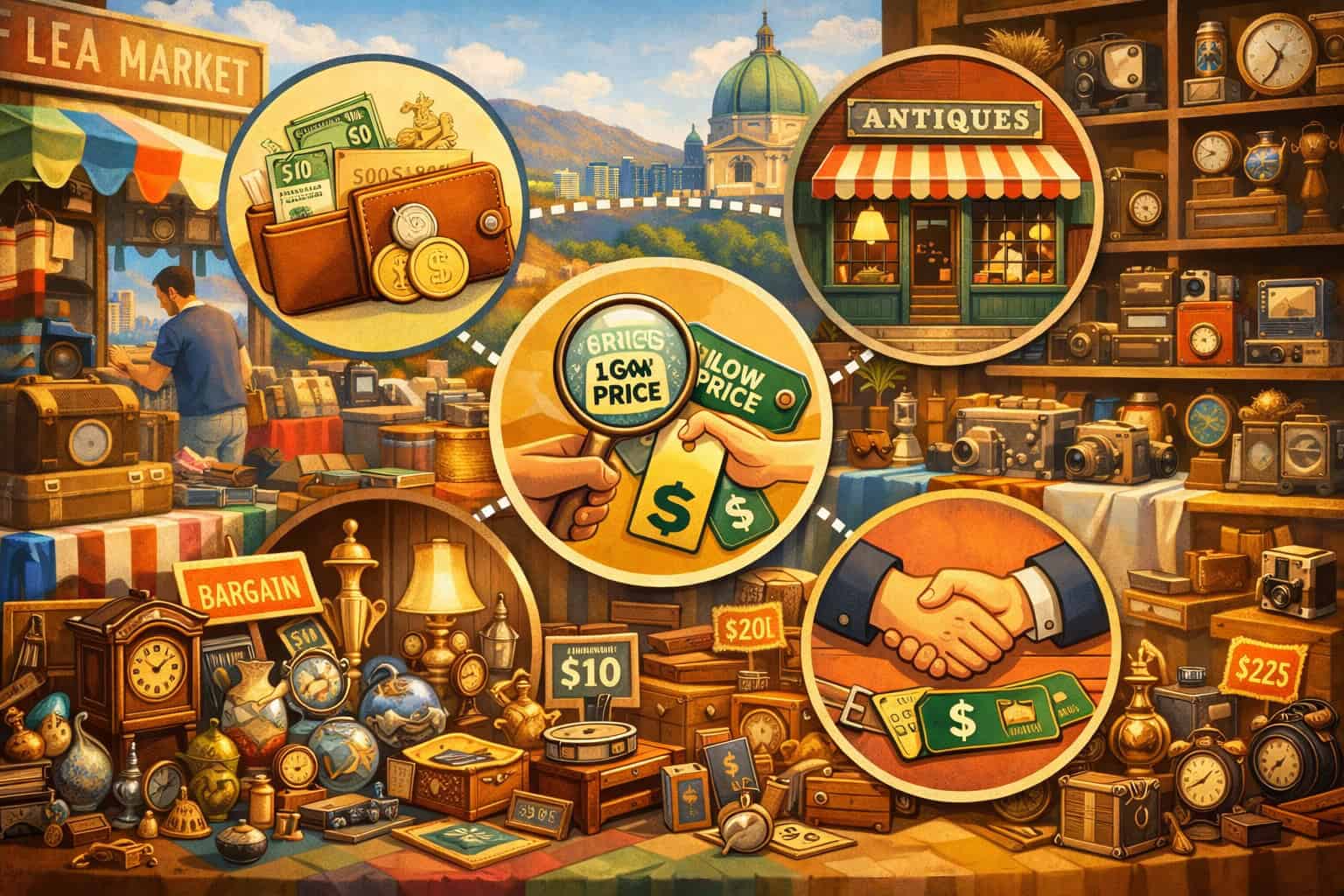
Collecting antiques on a budget in Montreal is one of those hobbies that can feel “high-end” without actually requiring high-end money.
The city rewards curiosity: you can walk from neighborhood to neighborhood, duck into a flea market, stumble into a tiny shop, and leave with a piece that has real age, character, and story—often for less than the price of a new, mass-produced equivalent.
What makes collecting antiques on a budget in Montreal especially fun is the mix. You’ll see European-style decorative pieces, North American practical antiques, mid-century modern furniture, vintage prints, old tools, retro kitchenware, and local maker items that have quietly become collectible.
It’s also a city where secondhand culture is strong, so “treasure hunting” doesn’t feel niche—it feels normal.
Another bonus: Montreal is walkable. You can build an inexpensive “antique circuit” around Mount Royal, which sits near the geographic heart of the city and anchors several neighborhoods known for vintage and decorative shopping. Mount Royal is often described as “the mountain,” a central landmark and heritage site tied to the city’s identity.
In this guide, you’ll learn practical ways to collect antiques on a budget in Montreal—where to shop, how to spot value, how to negotiate, how to avoid mistakes, and how to build a collection that looks intentional (not random).
You’ll also get a forward-looking view of what trends may shape prices and availability over the next few years, so your budget goes further.
Why Montreal Is a Budget Antique Hunter’s Dream

Collecting antiques on a budget in Montreal works because the city has multiple “supply streams” at once: flea markets, independent shops, estate sales, auctions, consignment, and neighborhood cleanouts.
You’re not limited to one expensive district or a single weekly market. Instead, you can rotate sources and let competition work in your favor—when one place is overpriced, another channel often isn’t.
Montreal’s density is also a budget advantage. In many cities, bargain antique hunting requires long drives. Here, you can plan a day that’s mostly walking, transit, or a short rideshare.
When your transportation costs are low, you can put more of your budget into the object itself. That matters a lot if your goal is collecting antiques on a budget in Montreal over months (not just one weekend).
The city’s history and layered architecture support the market too. Older buildings and long-established neighborhoods mean more “household antiques” circulate locally: frames, mirrors, lighting, small furniture, ceramics, and decor that were used for decades before being sold.
Some of the best budget finds are not museum-grade rarities—they’re everyday objects with age and quality that modern replacements can’t match.
Finally, Montreal’s relationship with Mount Royal subtly shapes shopping patterns. Mount Royal is a defining physical feature and a protected heritage area, surrounded by neighborhoods that have long been associated with culture, design, and older housing stock.
When you build your hunting routes around the mountain’s adjacent areas, you naturally pass through corridors where vintage stores, decor shops, and resale culture cluster.
If you want collecting antiques on a budget in Montreal to stay fun (instead of overwhelming), lean into what the city gives you: variety, density, and constant turnover.
Neighborhood Strategy: Build a “Mount Royal Loop” for Better Finds

A smart way to approach collecting antiques on a budget in Montreal is to stop thinking in single stops and start thinking in loops. A loop is a route where you can comparison-shop without backtracking, so you’re less likely to overpay.
The most practical loop concept uses Mount Royal as your anchor point because it’s close to the city center and connects naturally to several shopping-friendly areas. Tourisme Montréal describes Mount Royal as a beloved landmark at the city’s center, tied directly to Montreal’s name and identity.
Here’s why the “Mount Royal loop” helps your budget:
You can check multiple price tiers in one outing. A small shop with curated items might be higher-priced, but a few blocks away you may find similar style pieces for less. Seeing both in a single day trains your price instincts fast—critical for collecting antiques on a budget in Montreal.
You can carry small wins. When you’re on foot or using transit, you naturally focus on compact antiques: jewelry, prints, ceramics, small lighting, decorative objects, and tabletop items. These categories are where beginners often get the best value because condition issues are easier to spot and repair costs are lower.
You reduce impulse buys. Loop shopping forces pauses. If something feels expensive, you keep moving, gather context, and come back only if it still stands out. That single habit can save you hundreds over a year.
Mount Royal is also physically and culturally prominent—locals call it “the mountain,” and it sits immediately west of downtown. The neighborhoods around it are full of design taste and resale activity.
If your goal is collecting antiques on a budget in Montreal, build a regular weekend loop. Repetition is how you start catching underpriced items before someone else does.
Set Your Budget, Goals, and “Deal Rules” Before You Shop

Collecting antiques on a budget in Montreal gets dramatically easier when you decide what your budget is supposed to do. A budget isn’t just a limit—it’s a strategy. Without one, you’ll either overspend on one “pretty” object or underbuy random clutter that doesn’t build toward a collection.
Start with a monthly number you can stick to. Then break it into three buckets:
- Core collection (about 60%): These are the pieces that define your taste: one style of ceramic, a period of prints, a niche like vintage cameras, or a practical category like lighting. If you’re serious about collecting antiques on a budget in Montreal, you want most of your spend to reinforce your main lane.
- Upgrade fund (about 30%): This is for the “I found the right one” moment. Maybe you’re waiting for a better mirror, a higher-quality chair, or a signed print. Budget collectors often fail because they spend every dollar immediately and have nothing left when a true bargain appears.
- Learning money (about 10%): This is permission to make small mistakes. You might buy a $15 object to practice identifying maker marks, or a cheap frame to learn basic restoration. That’s still collecting antiques on a budget in Montreal—because education prevents expensive errors later.
Also define your deal rules before you start:
- Maximum repair budget per item
- No “mystery damage” purchases (unless it’s extremely cheap)
- No bulky items without a transport plan
- No purchases outside your lane unless they’re resale opportunities
This structure keeps collecting antiques on a budget in Montreal from turning into a storage problem—and it makes your collection look curated, even if every piece was affordable.
Define Your Collecting Lane: The Fastest Way to Save Money

If you want collecting antiques on a budget in Montreal to actually feel budget-friendly, pick a lane. A “lane” is your focus area, and it acts like a filter that protects your wallet. When you’re surrounded by hundreds of beautiful old objects, the risk isn’t that you won’t find anything—it’s that you’ll want everything.
Good budget lanes are:
- Small and shippable: Jewelry, postcards, maps, prints, small ceramics, vintage barware, textiles, tabletop antiques, and small lighting parts.
- Easy to authenticate: Silver hallmarks, clear maker marks on ceramics, printed publisher info on posters, or labeled jewelry.
- Common enough to find often: If your lane is too rare, you’ll be tempted to overpay “because you never see it.”
Montreal is perfect for lane collecting because the city’s mix of shops, flea markets, and estate channels gives you repeated exposure. Repetition builds pattern recognition. And pattern recognition is the secret weapon in collecting antiques on a budget in Montreal: it helps you spot the odd one out—the underpriced piece—fast.
If you’re unsure, choose a lane that improves your home. Many people start collecting antiques on a budget in Montreal by focusing on functional decor: mirrors, lamps, frames, and small tables.
Even modest upgrades can make your space look expensive without being expensive, and you’ll learn practical condition assessment along the way. Your lane can evolve. But at the beginning, focus is how you turn bargain hunting into real collecting.
Best Places for Collecting Antiques on a Budget in Montreal
Where you shop matters as much as what you buy. Some places are curated and priced accordingly; others are messy, chaotic, and full of deals—especially if you’re willing to dig. The good news is that collecting antiques on a budget in Montreal gives you both.
The most important shift is to use multiple channels. Don’t rely only on antique boutiques. Mix flea markets, auctions, and small shops, then compare. Over time, you’ll learn which categories are cheapest where.
Below are the best channels for collecting antiques on a budget in Montreal, with specific examples so you can plan real outings.
Marché aux Puces Saint-Michel: The Budget Collector’s Training Ground
If you’re serious about collecting antiques on a budget in Montreal, an indoor flea market is your skill-building headquarters. Marché aux Puces Saint-Michel is widely known as a year-round place to hunt antiques, collectibles, and vintage goods.
Why it’s ideal for budget collecting:
- Volume creates deals: Many vendors in one place means prices vary a lot. That’s good for you. Two stalls may have similar items priced very differently, and that’s where budget wins happen.
- You can practice without pressure: Even if you buy nothing, you’ll see enough objects in one visit to sharpen your eye. Collecting antiques on a budget in Montreal is a learned skill, and this market gives you “reps.”
- Negotiation is normal: Flea markets are more flexible than high-end shops. Bundling small items often works better than haggling hard on a single piece.
How to shop it like a pro:
- Do a full “scan lap” first. Take mental notes or quick phone notes on prices.
- Return to your top 3 stalls and compare condition and authenticity cues.
- Ask friendly questions (“Do you know the age?” “Any marks?”) before negotiating.
- Bundle: “If I take these three, what’s your best price?”
Markets like this also teach you what “too good to be true” looks like, which protects your budget later. If you can learn to collect antiques on a budget in Montreal in a flea market environment, you’ll be confident everywhere else.
Mile End and Avenue du Parc: Shop Smart in a Curated Neighborhood
Collecting antiques on a budget in Montreal doesn’t mean you avoid curated shops. It means you use them strategically. Some neighborhoods—like Mile End—have stores where the baseline price is higher, but the quality can be much better. That’s valuable when you’re looking for items that are hard to restore or expensive to replace.
A good example is Antiques Loft 9, a shop in Mile End on Avenue du Parc that lists a wide mix: vintage jewelry, antique furniture, paintings, and eclectic collectibles.
How to keep it budget-friendly in curated shops:
- Go for smalls and “edge items”: Big furniture is often priced for design buyers. But smaller items—frames, small art, decorative objects—can be surprisingly reasonable, especially if they’ve been sitting.
- Look for minor flaws: A tiny chip, a slightly loose fitting, or a missing screw can drop the price, and those are easy fixes. This is a classic tactic in collecting antiques on a budget in Montreal: buy what others overlook because it needs a simple repair.
- Ask about new arrivals and slow movers: Dealers know what sells fast. You’re interested in what doesn’t. “Do you have anything you’re trying to move?” can unlock discounts.
Even if you don’t buy, curated shops teach you how real quality feels—joinery, weight, glazing, patina. That knowledge makes collecting antiques on a budget in Montreal easier because you’ll recognize value when you see it in cheaper places.
Estate Auctions and “Succession” Sales: Budget Gold If You Do the Homework
A major advantage for collecting antiques on a budget in Montreal is access to estate-related selling channels. In the local context you’ll often see “succession” services—sales tied to transitions, downsizing, or estates—where items are cataloged and sold through auctions or structured sales.
One example: Encan West Island describes services tied to estate selling and auctioning valuables through a dedicated auction process. Another example: Les Encans Randall Finnegan notes they auction collectibles, antiques, and estate sales (and they even post recent update timestamps on their site).
Why auctions can be budget-friendly:
- You can sometimes buy quality pieces below retail, especially if demand is low that day.
- Lots can include “extras” (frames, hardware, small decor) that are cheap when bundled.
- Conditions are visible in photos and descriptions, so you can plan.
How to avoid overspending:
- Set a hard ceiling including buyer’s premium, tax, and pickup costs.
- Target categories that other bidders ignore (old tools, frames, small decor lots).
- Bid late and calmly; don’t chase.
Auctions reward preparation more than luck. If you build a habit—checking listings weekly—collecting antiques on a budget in Montreal becomes less about “finding something” and more about “waiting for the right thing at the right price.”
This is also the first moment where the country name becomes relevant: if you plan to ship items across borders (or buy from outside the country through online auctions), you’ll need to consider customs, duties, and carrier fees in Canada—which can erase a bargain fast. Keep most early collecting local to protect your budget.
Seasonal Pop-Ups and Neighborhood Markets: The Quiet Deal Zones
Not every bargain comes from a famous market. Some of the best wins in collecting antiques on a budget in Montreal come from pop-up events, church basements, community markets, and small weekend sellers.
These are “quiet deal zones” because sellers may not be professional antique dealers—and pricing can be closer to “I want this gone” than “I researched the market.”
How to win here:
- Bring small bills and a tote: It sounds simple, but it increases your ability to buy quickly when you find a deal.
- Ask origin questions: “Was this from your family?” sometimes reveals age and story. Provenance isn’t required, but it helps.
- Buy sets and pairs: Two matching candleholders, a pair of frames, or a small set of glasses usually looks more intentional in your home and can be cheaper per piece.
These settings are especially good for practical antiques—kitchenware, linens, books, and small decor. Over time, adding these categories is how collecting antiques on a budget in Montreal turns into a home that feels layered and personal, not showroom-generic.
How to Spot Real Antiques and Avoid Expensive Mistakes
Collecting antiques on a budget in Montreal is only a bargain if the item is real enough for your goals and stable enough to last. Budget collectors don’t need to be museum curators, but they do need a few fast checks to avoid paying antique prices for modern reproductions—or buying damage that costs more than the piece.
A good rule: You don’t need perfect certainty. You need a high probability. Build a simple checklist and use it every time. Your confidence will grow quickly, and that’s how collecting antiques on a budget in Montreal stops feeling like gambling.
Below are practical checks you can do in minutes.
Material Clues: Quick Authenticity Checks You Can Do in Under Two Minutes
Your fastest tools are your eyes and hands. Different eras leave different fingerprints in materials and construction.
- Wood and furniture: Look underneath. Machine-perfect cuts and identical screw heads often signal newer items. Older pieces may show hand-cut joinery, mixed fasteners from repairs, or uneven wear in logical places (edges, handles, feet).
- Ceramics and glass: Check the base. Many older pieces have unglazed rings, kiln marks, or maker stamps. In glass, look for seams (mold lines) and how the pontil area is finished. You’re not trying to “date it exactly”—you’re trying to avoid obvious modern mass-production when collecting antiques on a budget in Montreal.
- Metal items: Patina matters. True age usually shows a layered surface, not just artificial darkening. In silver, look for hallmarks. In brass, look for real weight and wear patterns that match how the object is used.
- Prints and paper: Look at the back. Old paper often has tone and texture. Frames can tell a story too: a genuinely old print in a cheap modern frame isn’t impossible, but it’s a flag to check more carefully.
If you’re unsure, treat uncertainty as a negotiation point. That keeps collecting antiques on a budget in Montreal safe: “I like it, but I’m not sure about the age—could you do a better price?”
Maker Marks, Labels, and Montreal Provenance: How to Add Confidence Without Overpaying
Marks matter because they narrow the universe. A signature, stamp, foundry mark, or label can move an item from “decor” to “collectible.” But here’s the budget twist: you don’t need the most famous names to build value.
Often the best strategy in collecting antiques on a budget in Montreal is to learn mid-tier marks and regional makers—items that are undervalued because not everyone recognizes them.
What to look for:
- Ceramic stamps (often on the base)
- Jewelry hallmarks (inside bands, on clasps)
- Furniture labels or burned-in marks
- Printer/publisher marks on art
- Old store labels (sometimes from local shops)
Provenance can be simple. If a seller says “This came from my grandparents’ place near Mount Royal,” that doesn’t prove anything on its own, but it hints that the object may have been in the city for decades, which can align with genuine age.
When you find a mark, do a quick phone search (even in-store). Just don’t get trapped in research while someone else buys it. A good compromise is to take clear photos, ask if the seller can hold it briefly, and decide quickly.
This balanced approach is what keeps collecting antiques on a budget in Montreal from turning into either overpaying or overthinking.
Restoration vs. Ruin: What’s Worth Fixing on a Budget
Budget antique collecting isn’t anti-restoration—it’s pro-smart restoration. The difference is cost predictability.
Worth fixing (usually):
- Loose hardware
- Minor scratches or small veneer chips
- Dirty surfaces that respond to gentle cleaning
- Rewiring lamps (if you factor the cost)
- Replacing missing screws or feet
Often not worth fixing (on a budget):
- Structural furniture damage (broken frames, major warping)
- Active woodworm/serious pest signs
- Heavy water damage (swelling, mold smell)
- Expensive missing parts that define the piece
- Large tears in upholstery unless you can DIY
A key tactic for collecting antiques on a budget in Montreal is to set a repair cap before buying. For example: “I will not spend more than 25% of purchase price on repairs.” If the math doesn’t work, walk away.
Also consider your time. A “cheap” project that takes three weekends and still looks rough is not always a bargain. The best budget antiques are often the ones that need only light cleaning and one small fix.
Negotiation and Timing Tactics That Actually Work
If you want collecting antiques on a budget in Montreal to be consistent, negotiation has to feel normal—not awkward. Most sellers expect some back-and-forth, especially in flea markets and when items have been sitting.
The goal isn’t to “win.” The goal is to reach a price that matches risk (unknown age, condition, repair needs) and your budget rules.
Timing is equally important. The same object can be cheaper at the end of a weekend, during slow seasons, or late in the day when sellers don’t want to pack it up again. Negotiation plus timing is where many budget collectors get 15–40% savings over a year.
Best Times to Shop in Montreal for Lower Prices
While every seller is different, these patterns often help collecting antiques on a budget in Montreal:
- Late-day shopping: Near closing time, especially on the last open day of a weekend market, sellers may accept lower offers to avoid hauling items back.
- After the first “rush” hour: Early morning can have the best selection, but also the firmest prices. Midday can be a sweet spot: less crowd pressure, more time to talk, and occasional flexibility.
- Seasonal dips: In many cities, deep winter can be slower for casual shoppers, which can reduce competition. Less competition can mean better deals—especially on decor and small furniture.
- Right after new stock arrives: This seems counterintuitive, but when a seller has volume, they may price some items quickly just to move them. If you visit the same places regularly, you’ll catch these moments—one of the best habits in collecting antiques on a budget in Montreal.
Also remember: “best time” depends on your category. If you collect small antiques (prints, jewelry, ceramics), you can shop anytime. If you’re hunting larger furniture, timing around transport availability matters too.
How to Negotiate Without Burning Bridges
The most effective negotiating style is friendly and specific:
- Start with curiosity: “What’s the story on this piece?”
- Then signal intent: “I really like it.”
- Then mention your constraint: “I’m collecting antiques on a budget in Montreal—could you do any better on the price?”
- Offer a number that feels fair, not insulting.
Bundling is often the best tactic. Instead of trying to cut one item in half, ask: “If I take these three, what could you do?” Sellers like moving more inventory at once.
Cash can help in some environments, but don’t assume everyone wants it. A polite question works: “Is there a cash price?” Keep it respectful and simple.
Finally, don’t argue. If the seller won’t move, thank them and leave your contact info if you’re comfortable. Sometimes they’ll reconsider later. Collecting antiques on a budget in Montreal is a long game—relationships can become discounts.
French and English: Small Communication Tips That Can Save You Money
Montreal is bilingual, and sellers vary. You don’t need perfect language skills to succeed at collecting antiques on a budget in Montreal, but a little effort can improve interactions.
Simple French phrases can help:
- “Bonjour!” (Always start with this.)
- “Combien pour ça?” (How much for that?)
- “C’est négociable?” (Is it negotiable?)
- “Merci beaucoup.” (Thank you very much.)
Why this matters: people are more flexible with buyers they like. A warm, respectful tone reduces friction, encourages conversation, and makes sellers more willing to bundle.
If you prefer English, that’s fine too. Just don’t jump straight into bargaining. Ask one question first. That signals you’re a collector, not a flipper trying to squeeze them.
This “human” approach is underrated—and it’s one of the cleanest ways to improve your results in collecting antiques on a budget in Montreal without changing anything else.
Transport, Storage, and Care on a Tight Budget
A lot of beginners overspend not on the antique—but on what happens after. Transport, cleaning supplies, storage bins, and repairs can quietly double the cost of collecting antiques on a budget in Montreal.
The solution is to treat logistics as part of your collecting system. If you already know how you’ll get an item home and how you’ll store it safely, you can buy confidently. If you don’t, the “deal” can become stressful.
Getting Your Finds Home Without Paying More Than the Item
Collecting antiques on a budget in Montreal is easiest when you plan purchases around mobility.
For smalls: Carry a tote bag, bubble wrap sheet, and a small rigid box. You’d be amazed how often a $2 packing habit prevents a $40 break.
For medium items: Measure what you can carry comfortably. If you rely on transit, set a size limit. If you use rideshare or carshare, keep a folding measuring tape and straps in your bag.
For furniture: Only buy if one of these is true:
- You have a vehicle ready
- The seller offers delivery at a price that keeps the item within budget
- You can return later with help and a plan
A pro tip: keep a “transport budget” line separate from your item budget. Even a small monthly amount makes it easier to say yes to a real bargain without breaking your total spending plan.
This is how collecting antiques on a budget in Montreal stays sustainable: you protect your overall cost, not just the sticker price.
Budget Cleaning and Preservation: A Simple Starter Kit That Works
You don’t need fancy products to care for antiques. You need gentle, consistent basics.
A practical starter kit:
- Soft microfiber cloths
- Mild dish soap (for some non-porous surfaces)
- Cotton swabs for crevices
- Soft brush (like a clean paintbrush) for dust
- Distilled water (useful for sensitive surfaces)
- Museum putty or simple stabilizers for display safety
Avoid harsh shortcuts. Strong chemicals, abrasive pads, and aggressive “polish everything” habits can damage finishes, remove patina, and reduce value. Patina is often part of why collecting antiques on a budget in Montreal is appealing—objects look alive because they’ve been used.
For wood, the safest approach is minimal: dust, lightly clean, then decide if it needs conditioning. For metal, avoid over-polishing unless you’re sure it’s appropriate. For paper items, keep them dry and away from direct sunlight.
The budget rule: spend small, protect big. A $10 cleaning habit can prevent a $100 mistake.
Small-Space Storage: How to Collect Without Creating Clutter
Many people in Montreal live in apartments. That’s not a barrier—it just means your collecting strategy should favor items that display well and store easily.
Tips that help collecting antiques on a budget in Montreal in small spaces:
- Store by category in labeled bins (ceramics, frames, textiles).
- Use vertical storage for prints and frames.
- Limit “projects” to one at a time. Projects pile up fast.
- Choose antiques that replace something you already own (upgrade mindset).
- Rotate displays seasonally instead of buying more shelves.
A surprisingly effective rule is “one in, one out.” If you buy a new vintage vase, donate or sell one modern decor item you’re replacing. That keeps your space calm and your collection intentional.
Small-space discipline also helps your budget—because clutter buying is usually emotional buying. Collecting antiques on a budget in Montreal works best when purchases are planned, not panic-driven.
Future Trends and Budget Predictions for Montreal Antique Collecting
If you want collecting antiques on a budget in Montreal to get easier over time, pay attention to trends. Trends influence price spikes, category scarcity, and how quickly items move.
The good news: the future likely supports budget collectors in several ways—especially through better online discovery, more estate digitization, and continued interest in sustainable shopping. The risk is that certain “Instagram-famous” categories can get pricey fast.
What May Get More Expensive: Design-Driven Categories and “Viral” Styles
Design trends can push prices up quickly, especially when a specific look becomes popular online.
Categories that often rise when trend cycles hit:
- Mid-century modern furniture and lighting
- Vintage Scandinavian-style decor (even when not truly Scandinavian)
- Statement mirrors and large frames
- Iconic chair silhouettes
- Certain collectible ceramics styles
If you’re collecting antiques on a budget in Montreal, the way to survive a trend cycle is to buy “near neighbors.” Instead of the most iconic version of a style, look for adjacent eras, lesser-known makers, or similar materials.
Another prediction: more shops may price-check online marketplaces in real time. That can raise average sticker prices. The counterplay is to become faster at spotting condition issues and undervalued categories.
Trend inflation doesn’t kill budget collecting—it just shifts where the bargains live.
What May Get Cheaper: Bulky Items, Mixed Lots, and “Too Much Work” Pieces
Some categories may stay accessible—or even get cheaper—because modern lifestyles reduce demand:
- Large formal dining sets
- Heavy china cabinets
- Very ornate Victorian-style furniture that doesn’t fit modern spaces
- Mixed lots from estate sales that require sorting
These can be excellent opportunities for collecting antiques on a budget in Montreal if you have space, transport, or a willingness to resell what you don’t need.
Also, as estate services and auctions continue to move online, more mixed lots will be sold in bulk. Prepared buyers who can pick out value quickly can do well in that environment.
In other words: convenience-driven buyers push money toward “ready-to-display.” Budget collectors can profit by embracing what requires a little effort.
The Big Shift: More Digital Estate Sales and Smarter Local Searching
Estate-related selling is increasingly organized and catalog-driven, which makes it easier to monitor opportunities without physically visiting every location. Sellers like Encan West Island describe a process built around cataloging, photographing, and auctioning items.
Expect more of this approach over time:
- Better photos and item descriptions
- More online bidding options
- More competition for “obvious” collectible pieces
- More overlooked bargains in mixed lots
For collecting antiques on a budget in Montreal, the implication is clear: the edge goes to collectors who specialize. If you know one category well, you can spot value even when everyone else is chasing the headline items.
Also expect location-based discovery to improve. As sellers and buyers use more precise neighborhood tagging and map listings, building a Mount Royal-centered loop (plus a few outlying targets like major flea markets) becomes even more effective.
FAQs
Q.3: What’s the cheapest way to start collecting antiques on a budget in Montreal?
Answer: The cheapest way to start collecting antiques on a budget in Montreal is to begin with one small, repeatable category and one consistent shopping route.
Pick something easy to carry and easy to assess—small ceramics, frames, prints, or vintage jewelry. Then commit to a weekly or biweekly routine that includes at least one high-volume stop (like a flea market) plus one curated stop (a shop where you can learn quality cues).
This works because consistency replaces luck. You’ll learn what average prices look like, which makes real bargains obvious. A high-volume market also gives you “practice inventory,” so even when you don’t buy, you’re learning.
Marché aux Puces Saint-Michel is specifically positioned as a place for discovery with many vendors and varied goods, making it useful for skill-building.
To keep it budget-safe, set three rules: a maximum per-item spend, a maximum monthly spend, and a repair cap. That way, your early purchases teach you without draining you. If you follow this method, collecting antiques on a budget in Montreal becomes a steady, affordable hobby—one that grows into a collection with real personality.
Q.2: Are flea markets better than antique shops for collecting antiques on a budget in Montreal?
Answer: For pure price, flea markets often win. For quality certainty, antique shops often win. The best answer for collecting antiques on a budget in Montreal is to use both—because they serve different purposes in your strategy.
Flea markets tend to offer wider price ranges and more negotiating flexibility. That’s why they’re ideal for bargain hunting, bundling, and finding underpriced “smalls.” A market like Marché aux Puces Saint-Michel is known as an indoor weekend destination for antiques, collectibles, and vintage goods, which naturally supports budget searching.
Antique shops, especially in design-aware neighborhoods, often have higher prices but better curation. That curation helps you learn what quality looks like. A shop such as Antiques Loft 9 highlights categories like vintage jewelry, antique furniture, and paintings in Mile End, which can be educational even when you don’t buy.
So, flea markets are better for deals. Shops are better for training your eye. Combining them is how collecting antiques on a budget in Montreal stays both affordable and smart.
Q.3: How do I avoid buying fakes or reproductions?
Answer: Avoiding fakes is mostly about building a repeatable inspection habit. In collecting antiques on a budget in Montreal, your goal isn’t perfect authentication every time—it’s reducing risk enough that your average purchase is solid.
Use a three-step process:
- Check construction and materials. Look underneath furniture, check the base of ceramics, inspect seams in glass, and look for natural wear patterns.
- Look for marks. Maker stamps, hallmarks, labels, signatures, and publisher details improve confidence fast.
- Match the price to the risk. If you can’t confirm age, don’t pay “proven antique” pricing.
Also, buy in categories where “real vs. reproduction” is easier to judge, especially early on. Prints with visible publisher info, silver with hallmarks, and ceramics with stamped bases are great for beginners. And when in doubt, treat uncertainty as a negotiation point or walk away.
Over time, the best protection is repetition. Visiting the same channels—like flea markets and reputable shops—builds your pattern recognition, and pattern recognition is the real defense in collecting antiques on a budget in Montreal.
Q.4: What should I collect if I live in a small apartment near Mount Royal?
Answer: If you’re close to Mount Royal, you’re in a great spot for collecting antiques on a budget in Montreal—especially if you focus on compact pieces that display well. In a small apartment, the best categories are items that create visual impact without taking floor space.
Smart small-space categories include:
- Framed prints, posters, and small paintings
- Mirrors (especially medium sizes)
- Ceramics and glassware (small sets or statement pieces)
- Vintage desk items (clocks, trays, bookends)
- Jewelry and small collectibles
Mount Royal is a central landmark and heritage area surrounded by dense neighborhoods, so you can build walkable shopping loops that let you browse often without transport costs. That regular exposure helps you wait for the right piece instead of buying bulky items out of impatience.
The best small-apartment rule is “upgrade collecting.” Each antique should replace something modern you already own. That keeps your space calm, your collection intentional, and your budget under control—exactly what collecting antiques on a budget in Montreal is supposed to achieve.
Q.5: Are auctions a good idea for beginners on a budget?
Answer: Auctions can be excellent for collecting antiques on a budget in Montreal, but only if you treat them like a planned purchase, not a thrill. Estate-focused auction services describe processes that involve cataloging and auctioning valuables, which can create opportunities for buyers—especially in mixed lots.
For beginners, auctions are best when:
- You set a firm maximum bid including fees and taxes
- You focus on categories you understand (or low-risk lots)
- You have a clear pickup plan
- You are comfortable with “as-is” condition
Auctions become dangerous when bidders chase emotion. That’s how budgets break.
A beginner-friendly approach is to target lots where one item covers most of the value and the rest is a bonus (extra frames, small decor, hardware). If you do this consistently, auctions can become one of the strongest engines for collecting antiques on a budget in Montreal—especially as more estate selling becomes organized and online.
Q.6: How can I tell if an antique is “worth it” even if it’s cheap?
Answer: A cheap price doesn’t automatically make an item a good buy. In collecting antiques on a budget in Montreal, “worth it” means one of three things:
- It fits your lane and improves your collection
- It has stable condition and low repair cost
- It has resale potential if you change your mind
Ask four questions:
- Do I know where this will go in my home?
- Can I clean or stabilize it easily?
- Is the condition problem cosmetic or structural?
- If I had to sell it, could I reasonably get my money back?
If the answer to at least two of those is “yes,” it’s usually worth considering. If all are “no,” even a low price can turn into clutter.
The best budget collectors treat cheap items as “cheap tuition” only when they learn something from them—like a new maker mark, a construction detail, or a restoration technique. That mindset keeps collecting antiques on a budget in Montreal both affordable and meaningful.
Conclusion
Collecting antiques on a budget in Montreal is easiest when you stop chasing random “finds” and start building a system: a lane, a route, a monthly budget, and a few reliable shopping channels.
Montreal’s density, resale culture, and variety of markets, shops, and estate-related channels make it uniquely friendly for budget collectors—especially when you anchor your routines around the neighborhoods near Mount Royal, a defining landmark at the city’s center.
The real skill isn’t spotting one great deal once. The real skill is repeating success: knowing where to look, what to ignore, how to check conditions quickly, and how to negotiate respectfully.
Flea markets like Marché aux Puces Saint-Michel help you build experience at scale, while curated neighborhoods and shops teach you what quality looks like. Estate auctions and succession services add another powerful channel—especially if you plan bids carefully and account for total costs.