
Shopping for antiques can feel like stepping into a living archive. Furniture, paintings, ceramics, clocks, silverware, glassware, lamps, books, mirrors, and small decorative objects may carry traces of earlier homes, changing design tastes, and traditional craftsmanship.
However, Montreal’s diverse secondhand market also includes vintage pieces, restored objects, reproductions, replicas, assembled items, and new décor intentionally designed to look old. These objects are not necessarily undesirable. A well-made reproduction can be attractive and useful, provided it is described honestly and priced accordingly.
Learning how to Avoid Fake Antiques When Shopping in Montreal is therefore not about distrusting every seller or rejecting every restored item. It is about checking whether the description, physical evidence, condition, documentation, and asking price tell a consistent story.
A printed label saying “antique” is not proof. Neither is a dark finish, a faded maker mark, surface cracking, heavy hardware, or a seller’s claim that an item came from an old estate. Reliable identification usually comes from several clues considered together.
This guide explains how to inspect antique furniture, ceramics, porcelain, glassware, metal objects, art, clocks, lamps, and decorative pieces. It also shows how to recognize misleading claims, ask useful antique dealer questions, research comparable items, and decide when professional appraisal is appropriate.
What Does It Mean to Avoid Fake Antiques in Montreal?
To avoid fake antiques in Montreal, shoppers must first understand what “fake” means. The word is often used too broadly. A recently made reproduction is not automatically fake, and an antique with replacement parts is not automatically fraudulent.
The main concern is misrepresentation. An object becomes problematic when it is intentionally or carelessly presented as older, rarer, more original, or more historically important than the available evidence supports.
For example, a modern chair inspired by an older French design may be a perfectly good decorative purchase. It becomes misleading when it is described and priced as an original period chair without supporting construction clues, documentation, or specialist review.
The same principle applies to ceramics with copied marks, decorative prints sold as original paintings, newly cast metal objects treated to resemble aged bronze, and furniture assembled from unrelated old and new components.
Fake antique identification is less about finding one magical test and more about comparing evidence. Materials, craftsmanship, wear, marks, repairs, provenance, and price should generally support the same conclusion.
Fake, Reproduction, Replica, and Antique-Style Items
A genuine antique is an older object whose age and identity are supported by its materials, construction, design, marks, history, or expert research. It may have wear, restoration, or replaced components, but those changes should be considered when it is described and priced.
A vintage item is older than a typical secondhand object but may not meet the commonly accepted age associated with antiques. Vintage objects can still be collectible, well made, and valuable.
A reproduction is a newer object created in the style of an earlier piece. A replica attempts to copy a specific design or object more closely. Antique-style décor borrows old-fashioned shapes, finishes, or decorative details without necessarily copying a particular original.
A fake or counterfeit antique is presented in a way intended to create an unsupported belief about its age, maker, material, origin, or rarity. An honest reproduction can be a satisfying purchase. The problem arises when modern production is hidden behind artificial wear, false marks, invented provenance, or exaggerated claims.
For additional background, this guide to the differences between antique and vintage items can help shoppers understand how common secondhand terms are used.
Why Fake Antique Identification Can Be Difficult
Fake antique identification can be challenging because objects change throughout their lives. Furniture may be refinished, reupholstered, shortened, repaired, or fitted with new hardware. Paintings may be relined or reframed. Lamps may be rewired, and clocks may contain replacement movements.
Natural aging can also resemble intentional distressing. Wood develops scratches, fading, oxidation, shrinkage, and colour variation. Metal tarnishes and corrodes. Ceramic glaze may craze, and paper can become brittle or discoloured.
At the same time, modern manufacturers can reproduce older shapes, decorative patterns, joinery, labels, and surface effects. Some reproductions are carefully made and may develop genuine wear after years of use.
This means that a shopper cannot reliably judge an object from its front surface alone. The underside, back, interior, fasteners, joints, hidden edges, base, frame, lining, and repair areas may provide more useful information.
The safest approach is to remain open-minded. Instead of trying to prove immediately that an item is genuine or fake, ask which explanation best fits all available evidence.
Fake Antique Warning Signs at a Glance
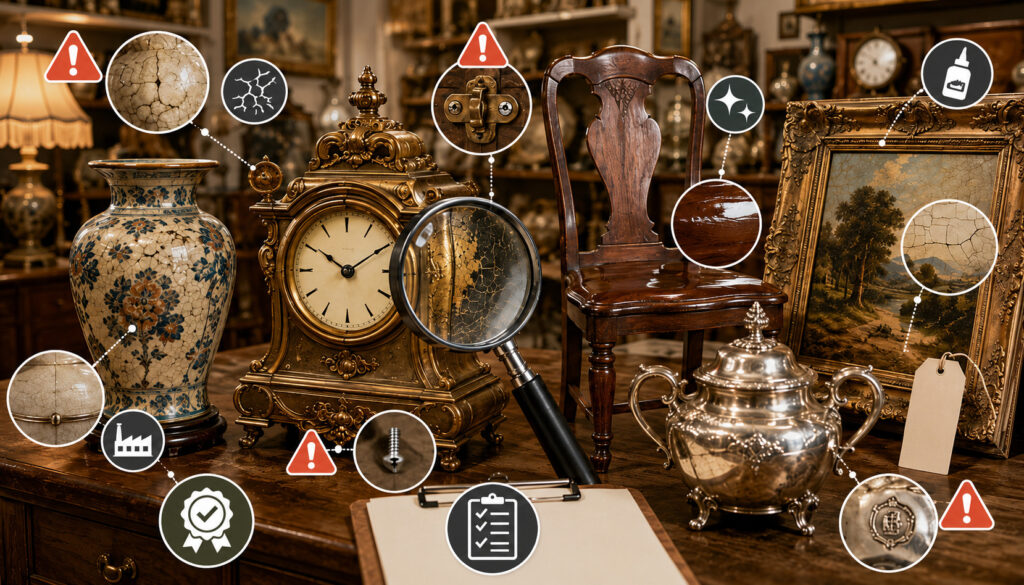
The following table provides a practical starting point for antique shopping Montreal stores, flea markets, estate sales, vintage shops, and private listings.
| Warning Sign | What It May Suggest | What to Inspect | Better Shopping Habit |
| Uniform wear | Artificial aging or decorative distressing | Handles, edges, feet, corners and protected areas | Compare high-use and low-use surfaces |
| New-looking hardware | Replacement parts or newer construction | Screws, hinges, pulls, nails and mounting holes | Check whether the hardware matches the object |
| Blurry maker mark | Copied, altered or poorly applied mark | Placement, lettering, glaze and surrounding wear | Research verified examples |
| Too-perfect condition | Newer reproduction or major refinishing | Underside, joints, interior surfaces and finish | Look for consistent age clues |
| Random scratches | Artificial distressing | Direction, depth, spacing and location | Ask whether the damage matches normal use |
| Vague “rare” claim | Unsupported marketing language | Documentation, comparable examples and maker history | Request specific evidence |
| No provenance | Limited ownership history | Receipts, estate notes, photographs and records | Adjust expectations and price |
| Mixed materials | Repair, alteration or assembled construction | Wood species, metals, fasteners and finish | Inspect every component |
| Weak construction | Decorative replica or low-quality production | Joinery, seams, frame, weight and stability | Judge craftsmanship separately from appearance |
| Pressure to purchase | Limited opportunity to research | Price, return terms and written description | Pause before paying |
A warning sign is an invitation to inspect more carefully, not an automatic verdict. New screws, for example, may indicate a sensible repair rather than a reproduction. An object without provenance may still be genuine, especially when it was an ordinary household item rather than a documented collectible.
How to Use the Warning-Sign Table
Begin with the seller’s description. Note every meaningful claim, including approximate age, maker, country or region of origin, material, restoration status, rarity, and whether the parts are believed to be original.
Next, examine the areas listed in the table. If a chest is described as old, compare the visible finish with the drawer interiors, back boards, feet, underside, and fasteners. If a vase is linked to a known maker, inspect the base mark, foot wear, glaze, shape, and decorative style.
Record concerns instead of making an instant judgment. A phone note might say, “new rear screws, older front hardware, refinished top, no restoration record.” This prevents one attractive feature from overshadowing several inconsistencies.
Use the table most carefully when the price depends on authenticity. A decorative reproduction at a modest price may not require extensive research. A supposedly rare, signed, or historically important object deserves a much higher standard of evidence.
Why One Warning Sign Is Not Always Proof
Authentic antiques commonly contain repairs and later components. A cabinet may have replacement hinges because the originals failed. A lamp may have modern wiring because using its original cord would be unsafe. A chair may have new upholstery over an older frame.
Natural variation also complicates identification. Handmade objects are not always irregular, while machine-assisted production is not always recent. Some historical workshops used standardized processes, moulds, templates, or manufactured hardware.
Conversely, several convincing-looking features do not prove authenticity. A copied mark may be applied to a well-made reproduction. Artificial patina may cover genuinely old wood taken from another object. A newer piece may use traditional dovetail joints.
The strongest conclusion comes from convergence. If the wood, joinery, tool marks, hardware, wear, finish, style, and documentation all support the same period, confidence increases. If several features conflict with the claimed age, more research is justified.
Avoid absolute statements unless you have appropriate expertise. Phrases such as “the hardware appears newer” or “the evidence does not support the seller’s age claim” are more responsible than declaring an object fake from one photograph.
Learn the Difference Between Old, Original, and Authentic
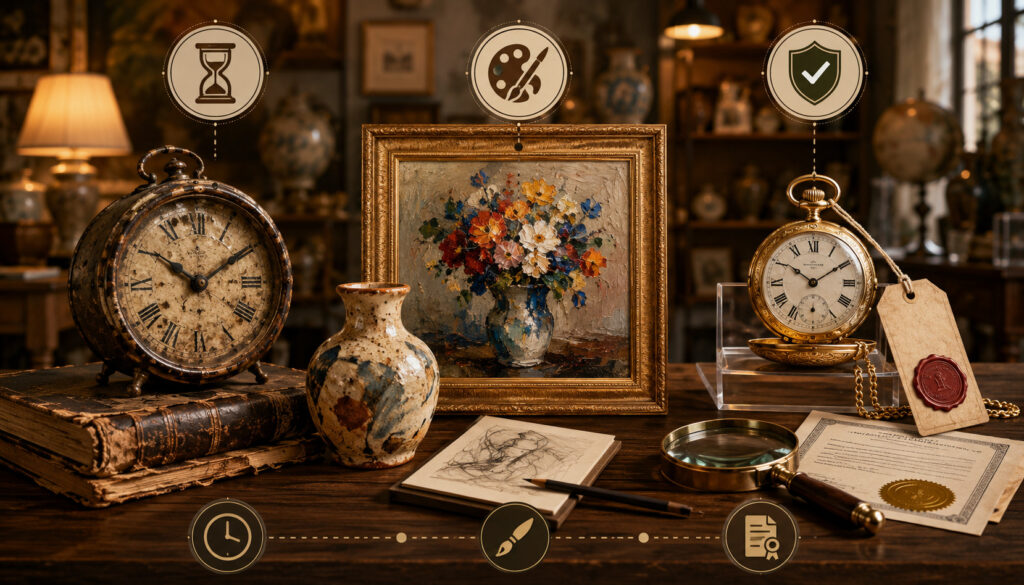
Age, originality, authenticity, condition, quality, rarity, and value are related but separate ideas. Confusing them is one of the most common reasons shoppers overpay.
An object can be genuinely old but poorly made. It can be authentic but heavily restored. It can be rare but unwanted by collectors. It can be newer yet beautifully constructed. It can also be historically interesting while having limited decorative or financial appeal.
Originality concerns how much of the object remains as it was first made. Authenticity concerns whether the object is truthfully identified. A period table with a replaced top may still have an authentic old base, but it should not be represented as completely original.
Condition describes physical survival. Cracks, losses, insect activity, corrosion, stains, unstable joints, fading, restoration, and missing parts affect condition. They do not always erase authenticity, but they may influence usefulness and the amount a buyer is comfortable paying.
When evaluating real vs fake antiques, ask separate questions:
- Does the object appear to have meaningful age?
- Does the claimed maker or origin fit the evidence?
- Which parts are original?
- What has been repaired, refinished, or replaced?
- Is the asking price based on age, quality, rarity, fashion, or appearance?
- Would the object still appeal to you if the strongest claim proved incorrect?
Start With the Item Category and Materials
The first practical step is to identify the item category. Furniture, porcelain, metalware, books, prints, clocks, textiles, and glass require different inspection methods.
Furniture may reveal useful evidence through joinery, secondary woods, drawer construction, tool marks, shrinkage, back boards, and hardware. Ceramic identification often depends more heavily on body composition, glaze, decoration, foot shape, and maker marks.
Glassware may require examination of seams, pontil areas, cut patterns, base wear, weight, colour, bubbles, and surface quality. Metal objects call for attention to casting, soldering, plating, corrosion, hallmarks, seams, and weight.
Materials should also fit the claimed period and function. MDF, modern resin, certain plastics, synthetic fabric, machine-cut panels, modern staples, and recently manufactured fasteners may reveal newer production or later alterations.
However, do not turn material clues into universal rules. Older objects may contain replacement plastic components, and some materials that appear modern have existed longer than casual shoppers expect. Research the specific category before relying on one feature.
A broad guide to spotting quality in bric-à-brac stores can help beginners develop better material and condition awareness.
Study Construction and Craftsmanship
Construction often tells a more reliable story than decorative style. A new object can imitate an old silhouette, but reproducing every hidden structural detail is more difficult and expensive.
On furniture, inspect drawer sides, drawer bottoms, corner blocks, back panels, legs, feet, underside surfaces, and joints. Look for evidence of hand shaping, machine cutting, later repairs, wood movement, and hardware replacement.
Dovetail joints can be useful, but they are not proof by themselves. Hand-cut dovetails often show slight variation, while machine-cut dovetails tend to be more regular. Nevertheless, modern craftspeople can cut joints by hand, and older factories could produce consistent work.
On ceramics, inspect mould seams, foot rings, glaze boundaries, painted decoration, transfer patterns, and firing imperfections. On metal objects, examine casting seams, soldered areas, screw threads, engraving, and the relationship between wear and raised details.
Construction quality should also be judged separately from age. An old object can be crudely assembled, and a modern reproduction can show excellent craftsmanship.
Look for Natural Patina Rather Than Decorative Distressing
Patina is the cumulative surface change produced by handling, exposure, oxidation, light, cleaning, use, and environmental conditions. It is not simply dirt, darkness, or damage.
Natural wear usually relates to function. Chair arms may be smoother where hands rested. Drawer pulls may show wear around frequently touched areas. Table edges may have small impacts, while protected undersides remain less worn.
Furniture feet may show cleaning marks or moisture exposure near the floor. Metal handles may have brighter areas where repeated touching removed oxidation. Paper may fade more strongly where it was exposed to light.
Artificial distressing often appears too evenly distributed or visually convenient. Repeated scratches may have similar depth and colour. Dark glaze may collect identically around every carved detail. Edges may be sanded even where normal use would not produce wear.
Also compare damaged areas with the material underneath. A fresh scratch through a dark “old” finish may reveal pale new wood. Recently created dents may have sharp edges, while older impacts often soften through handling and oxidation.
Do not try to clean suspected patina in the shop. Aggressive rubbing, polishing, or chemical testing can damage finishes and remove useful evidence.
Research Maker Marks, Labels, Signatures, and Hallmarks
Maker marks can narrow identification, but they are supporting evidence rather than automatic proof. Marks may be copied, forged, transferred, added later, misread, or used across different production periods.
Look beneath ceramic and porcelain objects, inside drawers, behind frames, under lamp bases, on clock movements, near furniture backs, inside metal pieces, and on book title or copyright pages.
Study how the mark interacts with the object. A ceramic mark beneath the glaze may differ in significance from one printed over it. A crisp stamp surrounded by heavily worn metal deserves closer attention. A paper label that looks much newer than the furniture may have been added later.
Compare lettering, symbols, spacing, colour, border shape, placement, and production technique with verified examples. Do not rely only on image-matching software, marketplace listings, or unsourced collector posts.
Signatures require similar caution. A signed painting is not automatically by the named artist. The signature’s paint, age, placement, style, and relationship to the image must be evaluated with the rest of the work.
For rare or high-priced objects, specialist reference books, museum catalogues, archive records, and professional evaluation are more appropriate than casual online comparison.
Ask for Provenance and Compare the Seller’s Story
Provenance is the known history of an object’s ownership, location, sale, exhibition, inheritance, or transfer. Strong provenance may include dated receipts, estate inventories, family photographs, correspondence, restoration reports, auction records, gallery labels, exhibition information, or earlier appraisals.
Not every genuine antique has paperwork. Everyday household objects often pass between generations without formal records. A lack of documentation should therefore be interpreted in context.
The standard should rise with the claim. An inexpensive unsigned bowl may reasonably have no history. A supposedly rare painting, important silver piece, or historically significant object should be supported by stronger evidence.
Ask the seller how the identification was made. Did the information come from a previous receipt, specialist, family record, catalogue, or visual assumption? Is the date exact or approximate? Are the parts believed to be original?
Documentation should also be examined critically. A certificate is only as reliable as its issuer and supporting research. A photocopied description, handwritten tag, or old-looking label does not independently establish authenticity.
Useful Documentation and Antique Dealer Questions
Before buying a higher-priced object, ask questions that invite specific answers:
- How was the age determined?
- Is the maker identification documented?
- Where did the item come from?
- Are any parts replaced or missing?
- Has it been refinished, repainted, rewired, rebacked, or reupholstered?
- Are there repair or restoration records?
- Is the mark original to the object?
- Is the frame, base, mechanism, or hardware original?
- May I photograph the mark and construction details?
- Is there a return period if the description proves materially inaccurate?
- Can the main age, material, and maker claims appear on the receipt?
Listen for the difference between knowledge and assumption. “The estate owner told me it belonged to her grandmother” is useful context but does not establish a production date. “It looks old” is an observation, not provenance.
A careful seller may openly acknowledge uncertainty. That can be more trustworthy than an overly precise story unsupported by evidence.
Compare the Story, Object, Price, and Comparable Examples
The seller’s story should agree with the physical object. A piece described as very old should not depend entirely on random scratches, a dark finish, and a paper label.
Check whether the materials, construction, decorative style, mark, hardware, condition, and claimed origin make sense together. An old-looking cabinet with uniform machine-cut panels, unused mounting holes, fresh screws, and artificial edge wear may be a later reproduction or heavily reconstructed piece.
Research comparable items with similar maker, material, dimensions, form, production method, condition, and documentation. Do not compare a verified signed object with an unsigned look-alike.
Listed prices are not the same as completed sales. Sellers may ask any amount, and unsold listings can remain online for long periods. Historical catalogues and museum collections are useful for studying form and attribution, while completed auction records may help reveal how condition and documentation affect demand.
A searchable archive of historical auction catalogues can provide useful context for researching documented objects and earlier descriptions.
Treat words such as “rare,” “original,” “museum quality,” “important,” and “investment piece” as claims requiring evidence. Ask what specifically supports them.
Inspect Different Antique Categories Carefully
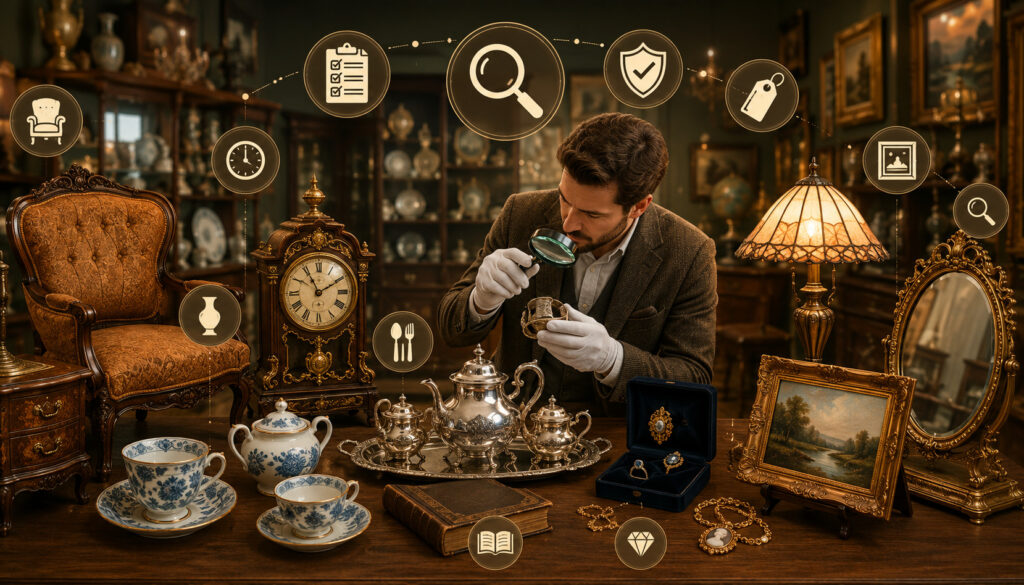
Fake antique warning signs vary greatly by category. Applying one universal rule can cause shoppers to reject genuine objects or accept convincing reproductions.
A useful inspection begins with category-specific evidence and then considers the object as a whole. When uncertainty remains, price the object according to what is known rather than what is merely possible.
Antique Furniture
Furniture should be inspected from every accessible angle. Open drawers, examine their sides and bottoms, look behind the piece, and inspect the underside with permission.
Check whether the wood species and colour remain consistent across visible and hidden areas. Secondary woods may legitimately differ, but abrupt changes can indicate repair or assembly from mixed parts.
Study dovetails, mortise-and-tenon joints, pegs, nails, screws, corner blocks, saw marks, veneer, and back boards. Look for unused holes showing that different hardware was once installed. Compare the wear beneath handles with the handles themselves.
New hardware on old furniture does not automatically make the piece fake. It may indicate restoration. The important question is whether the replacement is disclosed and whether the price assumes complete originality.
Overly perfect distressing is a stronger concern. Identical scratches, evenly sanded edges, repeated worm-like holes, and dark glaze applied uniformly into recesses may indicate decorative aging.
This detailed guide to spotting antique furniture in Mont-Royal provides additional examples of construction, provenance, and pricing clues.
Ceramics, Pottery, and Porcelain
Turn ceramic objects over and inspect the base, foot ring, glaze, marks, and areas of wear. Consider whether the base wear matches the condition of the rest of the item.
Copied marks are common on reproductions. Compare the mark’s colour, sharpness, placement, typography, and relationship to the glaze with reliable reference examples. A correct-looking mark on an incorrect shape or decoration should not be accepted without further research.
Inspect mould seams, handles, rims, lids, painted details, transfer decoration, gilding, crazing, cracks, chips, and repairs. Use angled light to look for overpainting, glue, filler, and differences in surface gloss.
Crazing is not proof of age. It can develop for several reasons and may appear on newer ceramics. Artificial staining can also make crazing look older.
Restored cracks and replaced handles may be difficult to see in normal shop lighting. A change in sound, texture, translucency, or colour may suggest repair, but do not strike or chemically test an object.
A national ceramics and glass conservation guide explains how materials, construction, handling, and deterioration affect these objects.
Glassware and Crystal
Hold glassware against a safe light source and rotate it slowly. Look for seams, bubbles, inclusions, scratches, cloudiness, chips, grinding, pontil marks, cut decoration, and base wear.
Handmade glass may show slight variation, but variation alone does not prove age. Machine-made glass can also contain bubbles and imperfections, while skilled contemporary makers may use traditional methods.
Inspect cut patterns carefully. Genuine cut decoration generally has physical depth and defined edges, while moulded patterns may feel softer. However, both techniques have long histories, so production method must be interpreted with the object’s design and claimed date.
Base wear should make sense. A supposedly old vase with a completely unworn base may deserve more scrutiny, but it may simply have been carefully stored. Conversely, scratches can be added intentionally.
Check rims for grinding and polishing. Examine stoppers, lids, and handles for fit, colour consistency, and wear. Components that do not align may have been replaced or paired later.
For valuable glass, attribution can depend on subtle production details. Seek specialist review rather than making a high-priced decision from weight, sound, or bubbles alone.
Silver, Brass, Bronze, and Other Metals
Begin by determining whether the object is solid metal, plated, coated, or made from a different metal beneath the surface. Inspect worn edges, raised details, feet, handles, joints, and interior surfaces.
Hallmarks and metal stamps may indicate maker, purity, region, assay information, or production details. They can also be copied, altered, or misunderstood. Compare the entire sequence, placement, punch shape, spacing, and wear with trustworthy references.
Plated objects may show a different base metal where the surface has worn through. That is a condition clue, not necessarily evidence of deception, provided the object is accurately described.
Natural oxidation often develops unevenly according to handling, air exposure, moisture, polishing, and contact with other materials. Artificial patina may collect too uniformly or appear inconsistent with protected areas.
Inspect solder joints, casting seams, repairs, replacement handles, drilled holes, and fresh engraving. A mark that cuts through old corrosion or appears much sharper than surrounding details may need further investigation.
Government conservation guidance notes that metals develop different corrosion products and require material-specific care. Avoid aggressive polishing because it can remove surface detail, plating, marks, and historical evidence.
Paintings, Prints, Photographs, and Frames
First determine what type of image you are examining. Paintings, drawings, etchings, engravings, lithographs, photographs, posters, digital reproductions, and decorative prints have different surfaces and production clues.
Use angled light to inspect texture. Visible texture does not always mean an original painting because reproductions can receive textured coatings or hand-applied highlights. Examine image edges, dot patterns, plate marks, paper texture, canvas, stretcher bars, backing, labels, and frame construction.
A frame may be older than the artwork, or the artwork may be older than the frame. Do not use the frame’s apparent age to date the image automatically.
Signatures should be evaluated alongside the artwork rather than treated as independent proof. Check whether the signature sits naturally within the paint layer and whether its style agrees with documented examples.
Look for trimmed margins, fading, water stains, foxing, tears, overpainting, relining, rebacking, and replaced stretchers. These conditions may affect identification and preservation.
Signed, expensive, historically significant, or heavily restored art should be reviewed by a qualified specialist before purchase.
Clocks, Lamps, Mirrors, and Functional Antiques
Functional antiques require both authenticity and safety checks. A clock may have an older case with a replacement movement. A lamp may combine an old base, newer socket, reproduction shade, and modern wiring.
Inspect screw types, mounting holes, mechanisms, labels, dials, hands, wiring routes, sockets, switches, cords, and repairs. Components should fit the object physically and stylistically.
Working condition does not establish originality. A clock may function because its mechanism was replaced. A lamp may operate after rewiring. These changes can be practical and responsible, but they should be disclosed.
Mirrors may contain replacement glass or backing. Look for changes around the frame edge, new fasteners, modern board, uneven fitting, or evidence that the opening was altered.
Safety takes priority over historical appearance. Frayed cords, unstable bases, exposed connections, overheated sockets, damaged plugs, or improvised repairs should be reviewed by an appropriate qualified professional before use.
Never plug an unverified antique lamp into a shop outlet merely to test it.
Watch for Mixed Pieces, Restoration, and Hidden Alteration
A “married” or assembled piece contains parts that did not originally belong together. This may occur with clocks, lamps, furniture, mirrors, frames, ceramics, metal objects, and decorative accessories.
Mixed pieces can still be attractive, functional, and worth owning. The issue is whether they are described as fully original when important components come from different objects or periods.
Look for mismatched wear, different screw types, inconsistent wood, awkward proportions, misaligned holes, abrupt changes in finish, and components that do not fit cleanly.
Restoration also requires context. Reupholstery, rewiring, refinishing, repainting, replaced hardware, repaired ceramics, polished metal, rebacked frames, and strengthened joints can make objects usable and stable.
An honestly restored item may be a better choice for everyday use than a fragile untouched piece. Hidden alteration is more concerning because the shopper cannot evaluate condition, originality, or future care accurately.
Honest Restoration Versus Misleading Change
Ask what work was performed, why it was necessary, who completed it, and whether photographs or records are available.
On furniture, check whether stripping removed the original surface, whether veneer was replaced, whether drawers were rebuilt, and whether structural repairs are stable. On ceramics, ask about filled chips, repainted decoration, replaced handles, and repaired cracks.
On art, ask about cleaning, relining, retouching, varnish, rebacking, and frame replacement. On metal, ask whether polishing removed patina or softened marks. On clocks and lamps, identify replaced mechanisms and electrical components.
Restoration should be judged according to purpose. A collector seeking originality may view refinishing differently from someone furnishing an apartment. Neither goal is wrong, but the description and price should reflect the object’s actual condition.
Do not attempt destructive tests, remove labels, scrape finishes, loosen components, or apply solvents. Qualified conservators use controlled methods because seemingly harmless actions can permanently alter an object.
Return Policies, Receipts, and Written Claims
Ask about return terms before paying. Many antiques, estate-sale objects, and flea-market purchases are final sale. Do not assume that discovering an issue later will create a right to return the item.
For expensive or difficult-to-identify objects, request a short inspection or approval period when possible. Clarify whether deposits are refundable and whether pickup deadlines, storage charges, or transport risks apply.
Keep the receipt and ask that important claims appear in writing. Useful details may include the stated maker, approximate period, material, known restoration, and whether the object is described as original or reproduction.
Avoid relying entirely on verbal assurances. A written description helps both buyer and seller remember what was represented.
For online purchases, review photographs, seller identity, shipping terms, damage policies, and the exact description before sending payment. General consumer guidance for online shopping recommends checking whether a seller is legitimate and understanding the transaction before purchasing.
Know When to Request Professional Appraisal
A casual seller opinion, identification, valuation estimate, conservation assessment, and formal appraisal are not the same service.
A professional appraisal generally involves research, object examination, a defined purpose, supporting evidence, and written conclusions. Requirements may differ depending on whether the appraisal is intended for insurance, estate administration, donation, division, resale planning, or another purpose.
Expert help is especially important for rare, expensive, inherited, historically significant, insured, or potentially valuable items. Art, jewellery, silver, rare books, archaeological material, signed decorative arts, and objects linked to an important maker may require category-specific expertise.
Choose an expert whose experience matches the object. A general furniture specialist may not be the right person to assess a painting, clock movement, textile, or rare ceramic mark.
Ask about qualifications, fees, scope, potential conflicts, and whether the professional buys or sells the same category. An independent review can be particularly useful when the purchase price depends heavily on attribution.
Antique Authenticity Checklist
Use this checklist before making a significant purchase.
| Checklist Area | What to Inspect | Fake Antique Warning Sign | Priority |
| Materials | Wood, metal, ceramic, glass, paper and fabric | Modern substitute inconsistent with the claim | High |
| Construction | Joinery, seams, fasteners and assembly | Uniform machine-made details presented as handmade | High |
| Patina | Wear, oxidation, fading and handling | Decorative or evenly distributed distressing | High |
| Marks | Labels, stamps, signatures and hallmarks | Blurry, copied, fresh or mismatched mark | High |
| Provenance | Receipts, history and ownership records | No support for a rare or valuable claim | Medium to high |
| Condition | Cracks, repairs, refinishing and losses | Hidden or undisclosed alteration | High |
| Components | Frames, hardware, mechanisms and bases | Mixed or replaced parts described as original | High |
| Price | Comparable verified objects | Premium price without supporting evidence | High |
| Seller claims | Age, maker, origin and rarity | Vague answers, contradictions or pressure | High |
| Expert review | Specialist inspection when appropriate | Review is discouraged or prevented | High |
Do not treat the checklist as a scoring system in which several positive answers guarantee authenticity. Its purpose is to organize questions and reveal areas requiring more research.
When a high-priority category is uncertain, delay the purchase unless the price reflects that uncertainty.
What to Bring to an Expert and What Records to Keep
Bring clear photographs of the front, back, sides, base, underside, marks, labels, hardware, damage, and repair areas. Include dimensions, weight when relevant, seller information, receipts, ownership history, and any previous research.
Do not clean, polish, refinish, repair, or remove labels before evaluation. Alteration may destroy evidence needed for identification.
After buying, retain:
- Original photographs and listing screenshots
- Receipts and written seller claims
- Provenance notes and correspondence
- Images of maker marks and construction details
- Appraisal or specialist reports
- Restoration and conservation records
- Transport and condition notes
- Any packaging, labels, or detached components
These records may help with future care, identification, insurance discussions, inheritance, or resale disclosure.
A national collection-care resource also provides material-specific information about furniture, paper, textiles, ceramics, glass, metals, and mixed objects.
Common Mistakes That Lead Shoppers to Buy Fake Antiques
The first common mistake is trusting the label. Tags are often written from previous-owner statements, visual impressions, or incomplete research.
Another mistake is assuming that anything heavy, dark, cracked, dusty, handmade-looking, or found at an estate sale must be old. These features can appear on reproductions and newer decorative pieces.
Many shoppers focus entirely on appearance. They admire the carved front of a cabinet but ignore the back, drawer interiors, underside, fasteners, and replaced top.
Others overvalue maker marks. A famous-looking stamp can create immediate excitement, but the mark must agree with the object’s materials, style, production technique, and condition.
Buying under pressure is equally risky. Urgency reduces the time available for photography, comparison, questions, and independent thought.
Ignoring restoration can also lead to disappointment. Repairs may be acceptable, but they should be understood before the price is evaluated.
Finally, some shoppers buy mainly because they hope an object is valuable. This encourages optimistic interpretation of weak evidence.
Believing Claims and Focusing Only on Appearance
Respectful skepticism is an essential antique shopping habit. Sellers may be honest yet mistaken, especially when they repeat information supplied by a previous owner.
Replace the question “Is this definitely real?” with more useful questions:
- Which physical details support the identification?
- What evidence conflicts with it?
- How certain is the seller?
- What would a verified example look like?
- Is the price reasonable if the attribution is incorrect?
Appearance should be only one part of the decision. A convincing old-style finish can hide modern construction. A plain or refinished surface may cover a genuinely older structure.
Examine functionality and condition as well. Check whether furniture is stable, lids fit, drawers move, glass is chipped, frames are secure, and repairs are sound.
A beautiful object with uncertain age may still be worth buying for decoration. The safest approach is to pay for the qualities you can confirm rather than the story you hope is true.
Build Knowledge Before Buying Expensive Pieces
Beginners can reduce risk by choosing one or two categories and studying them repeatedly. Compare several pieces of similar furniture, pottery, glass, prints, or metalware before attempting to identify rare examples.
Handle objects when permitted. Notice weight, balance, joinery, glaze, edges, surfaces, and signs of repair. Repetition builds pattern recognition.
Visit a mixture of curated shops, markets, estate sales, and exhibitions. Even when you purchase nothing, observe how descriptions and prices vary.
Study verified museum examples and reputable catalogues. Keep photographs of maker marks, construction details, and common reproduction signs on your phone.
Set a learning budget. Small, affordable mistakes can be educational, while an expensive mistake can be discouraging.
This guide to collecting antiques on a budget in Montreal offers additional ideas for comparing shops, setting limits, and developing category knowledge.
How Beginners Can Shop for Authentic Antiques Montreal With Confidence
Confidence does not require instant certainty. Good antique shoppers are comfortable saying, “I do not have enough evidence yet.”
Begin with easier, lower-risk categories and objects you genuinely enjoy. Small framed prints, books, simple ceramics, modest decorative metalware, and sturdy furniture can provide useful practice without requiring rare-object expertise.
Prepare a budget that includes transport, repair, rewiring, framing, cleaning, and professional review. A low purchase price can become expensive when an item needs major restoration.
Shop slowly. Complete an initial scan before making offers. Compare similar items in the same market, and take a short break before purchasing something costly.
Ask calm questions and avoid challenging the seller. The goal is to collect information, not win an argument.
Most importantly, separate decorative satisfaction from collectible value. An attractive reproduction can be an excellent home object when it is honestly described and reasonably priced.
Start With Easier Categories and Learn From Every Trip
Beginners may find it easier to evaluate items with visible construction and modest prices. A small table allows inspection of wood, joints, hardware, and wear. A simple ceramic bowl allows examination of glaze, base, mark, and condition.
Avoid beginning with categories in which tiny attribution differences create large price differences. Signed art, rare silver, jewellery, archaeological objects, and historically important material often require specialist knowledge.
Use every trip as observation practice. Compare how different sellers describe similar objects. Notice which flaws are disclosed and which require careful inspection.
Keep a short notebook containing:
- Categories and makers you are studying
- Typical dimensions and materials
- Common marks and reproduction signs
- Prices of comparable examples
- Questions that produced useful answers
- Mistakes you want to avoid repeating
Over time, you will become faster at identifying inconsistencies. Expertise grows through repeated comparison, not through memorizing a single list of rules.
Use the Five-Question Fake Antique Test
Before paying, ask five final questions:
- Do the materials and construction support the age claim?
Check wood, metal, glass, ceramic body, paper, fabric, fasteners, joints, and production techniques. - Does the wear make sense for the object’s use?
Compare touched surfaces with protected areas and look for repeated decorative distressing. - Are the marks believable and consistent with the item?
Consider placement, application, typography, wear, style, and verified examples. - Is the price supported by comparable documented objects?
Compare the same maker, material, form, dimensions, condition, and level of documentation. - Would I still want the object if it were newer or less valuable than claimed?
This question reduces emotional risk. If the answer is yes and the price is reasonable as décor, uncertainty may be acceptable. If the purchase depends entirely on rarity or investment potential, seek stronger evidence.
The test is not a substitute for professional evaluation. It is a final pause that helps shoppers avoid rushed, story-driven decisions.
When to Walk Away
Walk away when the seller prevents reasonable inspection, refuses basic questions, changes the story repeatedly, discourages independent review, or uses intense pressure.
Other reasons to pause include:
- Materials inconsistent with the claimed age
- Suspiciously fresh marks or labels
- Severe structural damage
- Active insect evidence
- Extensive hidden repair
- Missing components
- Unsafe wiring
- Strong odours, mould, or contamination
- Unsupported rare or original claims
- A price based on uncertain attribution
- Return terms that create unacceptable risk
Walking away is not an accusation. It simply means the available evidence does not justify the decision.
There will be other objects. Patience is one of the most useful antique buying tips Montreal shoppers can develop.
Best Practices to Avoid Fake Antiques When Shopping in Montreal
The best way to avoid fake antiques in Montreal is to follow a repeatable process rather than relying on intuition alone.
Learn the difference between antique, vintage, reproduction, restored, altered, and assembled objects. Begin with the item category and identify which clues matter most for that material.
Inspect visible and hidden construction. Compare wear patterns, hardware, marks, labels, repairs, and surface condition. Ask how the seller reached the identification and whether restoration has occurred.
Research comparable verified objects instead of relying on asking prices. Treat promotional words as claims requiring evidence.
Before paying, confirm return terms and request important statements in writing. Keep receipts, photographs, listing screenshots, research notes, and restoration records.
Use extra caution with signed art, silver, jewellery, rare books, high-priced furniture, and historically significant objects. Request qualified expert review when attribution has a major effect on the price.
Do not perform destructive testing, aggressive cleaning, scraping, polishing, or disassembly. Preservation resources emphasize that inappropriate handling and treatment can damage cultural objects and remove important surface evidence.
Finally, buy pieces you genuinely like. Personal usefulness and visual appeal remain valuable even when an object is not rare.
Frequently Asked Questions
How can I avoid fake antiques when shopping in Montreal?
Inspect the object rather than relying on its label. Compare materials, construction, natural wear, maker marks, repairs, provenance, seller claims, and comparable examples.
Ask how the age and maker were identified. Photograph hidden areas and research the item before paying a premium price. For rare, expensive, historic, signed, or inherited objects, seek an appropriate specialist.
What are the most common fake antique warning signs?
Common warning signs include uniform distressing, new hardware presented as original, blurry or suspicious marks, fresh scratches, mismatched components, modern materials, vague rarity claims, weak provenance, and pressure to buy quickly.
One sign is not conclusive. Several inconsistencies affecting materials, construction, wear, and documentation deserve closer investigation.
How can a beginner spot fake antiques in Montreal?
Choose a category and study verified examples before shopping. Inspect the underside, back, interior, base, fasteners, and repair areas.
Compare several similar objects, ask specific questions, and keep a checklist. Begin with modestly priced pieces so that uncertainty does not create major financial risk.
Are reproductions always bad when antique shopping?
No. Reproductions can be well made, attractive, functional, and appropriate for everyday decorating. The important issues are honest description and fair pricing.
A reproduction becomes problematic when it is presented as a genuine period object or given a false maker, age, or provenance.
Are maker marks enough to prove an antique is real?
No. Marks can be copied, added, altered, transferred, worn, or misidentified. Some makers also used different marks during different production periods.
The mark must agree with the object’s shape, materials, construction, decoration, condition, and claimed date. High-value attribution may require specialist research.
What should I ask before buying an expensive antique?
Ask how the seller determined the age, maker, origin, and material. Request details about repairs, refinishing, replaced parts, provenance, prior appraisals, and return terms.
Ask whether the main claims can be written on the receipt and whether an independent inspection is permitted.
When should I get a professional antique appraisal?
Consider professional assistance when an item is rare, expensive, inherited, historically important, signed, intended for insurance, or difficult to identify.
Choose an expert familiar with the specific category. Furniture, paintings, silver, jewellery, clocks, ceramics, books, and textiles may require different expertise.
What should I do when I am unsure whether an antique is authentic?
Pause the purchase and collect more information. Take photographs, record measurements, research verified examples, and ask follow-up questions.
If uncertainty remains, either seek specialist review, negotiate a price based only on confirmed qualities, or walk away. Avoid paying a premium for an unsupported possibility.
Conclusion
Learning how to Avoid Fake Antiques When Shopping in Montreal requires patience, observation, research, and careful questioning. No single mark, scratch, label, joint, or ownership story can establish authenticity by itself.
Begin with the category and materials. Study construction, tool marks, hardware, surface wear, patina, maker marks, signatures, hallmarks, and hidden areas. Ask about provenance, replaced parts, restoration, refinishing, and documentation.
Compare the seller’s story with the physical object. Research similar verified examples and be cautious when words such as “rare,” “original,” or “museum quality” are not supported by clear evidence.
Recognize that restoration and reproduction are not automatically negative. An honestly described restored antique or well-made reproduction may be a satisfying purchase. Misrepresentation is the real concern.
Keep photographs, receipts, written claims, research, and restoration records. Check return terms before paying, especially when buying online, at an estate sale, or through a private seller.
Most importantly, avoid pressure. Genuine confidence develops by combining multiple clues, accepting uncertainty, and requesting expert review for rare, expensive, historic, inherited, insured, or potentially valuable objects.
A careful shopper does not need to identify everything immediately. The ability to pause, investigate, and walk away is often the strongest protection against fake vintage items Montreal buyers may encounter.