Montreal offers an exciting environment for people who enjoy antique furniture, vintage décor, old books, ceramics, glassware, framed art, clocks, lamps, mirrors, textiles, and unusual collectibles. Shoppers may discover interesting objects in antique stores, estate sales, flea markets, thrift shops, secondhand markets, and neighbourhood vintage stores.
However, an item that looks old is not automatically an antique. Montreal’s secondhand market can include genuine antiques, later vintage pieces, repaired objects, carefully restored furniture, decorative reproductions, replicas, and recently manufactured items designed to appear aged.
Learning how to identify authentic antiques in Montreal therefore requires more than checking for dust, scratches, darkened wood, or an old-looking label. A careful shopper examines the item’s materials, craftsmanship, construction, maker marks, patina, condition, repairs, provenance, and consistency.
Authentic antique identification is rarely based on one perfect clue. Instead, it involves gathering several pieces of evidence and deciding whether they support the same story.
This guide explains the inspection process in a practical way. It is intended for beginners, collectors, decorators, tourists, resellers, estate sale visitors, and anyone interested in vintage and antique finds Montreal shoppers may encounter.
What Does It Mean to Identify Authentic Antiques in Montreal?
To identify authentic antiques in Montreal, shoppers examine an object to determine whether its materials, construction, style, markings, wear, and history are consistent with genuine age. The goal is not always to determine an exact manufacturing date while standing in a shop.
A more realistic goal is to decide whether the item appears to be genuinely old, later vintage, restored, altered, reproduced, or simply made in an antique-inspired style.
The process begins with observation. A buyer might examine the underside of a table, the back of a frame, the base of a ceramic vase, the movement inside a clock, or the title page of a book. These less visible areas often provide more useful information than the attractive front surface.
Authenticity should also be separated from value. An object can be genuinely old but common, damaged, heavily repaired, or unpopular with collectors. A newer reproduction may be well made, decorative, and useful even though it is not an authentic antique.
Readers who are still learning age terminology may find this guide to antique versus vintage differences helpful before comparing objects in person.
Antique vs. Vintage vs. Reproduction
An antique is commonly understood as an object that has reached a significant age, often roughly a century or more, although terminology can vary by category, market, and region. Antiques may include furniture, ceramics, silver, paintings, textiles, clocks, books, tools, jewellery, and decorative objects.
A vintage item is usually newer than an antique but associated with a recognizable earlier period. Vintage pieces may still have excellent craftsmanship, distinctive materials, cultural interest, and decorative appeal.
A reproduction is a newer object intentionally based on an older design. A replica attempts to copy a specific object or style, while an antique-style item borrows visual features such as carved decoration, dark finishes, ornate hardware, or artificial wear.
None of these labels automatically determines quality. Problems arise when a newer item is represented as an authentic antique without supporting evidence.
Beginners should focus on accurate description rather than prestige. Knowing whether an item is antique, vintage, restored, or reproduced makes it easier to compare condition, price, usefulness, and personal appeal.
Why Authenticity Can Be Complicated
Authenticity is complicated because objects change throughout their lives. Furniture may be refinished, reupholstered, shortened, repaired, or fitted with replacement handles. Paintings may be cleaned, relined, reframed, or retouched. Books may be rebound, and clocks may contain movements assembled from several sources.
An object can therefore contain both old and new components. A chest may have an older case but modern drawer pulls. A lamp may have an antique base with newer wiring and socket parts. A framed print may be old while its backing, mat, and frame are recent.
Sellers may also use broad descriptions such as “old,” “period style,” “heritage,” or “antique look.” These phrases do not necessarily confirm age.
Honest mistakes are possible as well. Family stories can become less accurate over time, labels can be misunderstood, and copied maker marks may appear convincing.
For these reasons, authentic antique identification should consider the complete object. Materials, construction, wear, style, marks, documentation, and repairs should support one another rather than contradict one another.
Authentic Antiques in Montreal at a Glance
The following table provides a quick starting point for antique shopping Montreal beginners. It is not a substitute for deeper research, but it can help shoppers decide where to look and which questions to ask.
| Item Category | Possible Authenticity Clues | What to Inspect | Common Warning Signs |
| Furniture | Joinery, solid wood, tool marks, hardware, consistent wear | Drawers, legs, underside, back, finish and repairs | New screws, uniform distressing, mismatched hardware |
| Ceramics | Maker marks, glaze, shape, foot-ring wear and decoration | Base, rim, glaze, cracks, chips and repaired areas | Blurry marks, fresh chips, copied decoration |
| Glassware | Weight, cutting, pontil clues, pattern and base wear | Rim, base, seams, clarity, bubbles and scratches | Strong mold seams contradicting handmade claims |
| Silver and metal | Hallmarks, weight, oxidation, soldering and polish wear | Marks, joints, plating, repairs and corrosion | Fake stamps, plating loss hidden by heavy polish |
| Art and frames | Signature, labels, canvas or paper, frame construction | Back, corners, surface, stretcher, mat and backing | New materials supporting unsupported age claims |
| Books | Publisher information, edition statement, paper and binding | Title page, copyright details, pages, spine and repairs | Missing pages, facsimile pages, undisclosed rebinding |
| Clocks | Movement, maker marks, dial, case and mechanical consistency | Mechanism, case, hands, repairs and replaced parts | Mixed components presented as entirely original |
| Lamps | Base material, socket style, shade, maker label and construction | Wiring, cord, stability, switch and repairs | Unsafe wiring or a new lamp presented as antique |
| Mirrors | Frame joinery, backing, glass character and natural wear | Backboards, frame corners, silvering and repairs | Artificial distressing or newly aged mirror glass |
| Collectibles | Materials, maker information, provenance and original parts | Labels, packaging, completeness and condition | Unsupported “rare” claims or recently added labels |
How to Use the Table
Use the table as an inspection map rather than a pass-or-fail test. Begin by identifying the object category, then focus on the areas most likely to contain useful clues.
For furniture, open every accessible drawer and examine the underside. For ceramics, turn the item over carefully and inspect the foot ring, maker mark, glaze, and signs of repair. For artwork, request permission to view the back rather than judging only the visible image.
When visiting Montreal vintage shops, flea markets, estate sales, or secondhand markets, use the table to slow down the buying process. Choose one category at a time and compare several objects before making a decision.
Photograph marks, labels, joinery, repairs, and overall proportions when the seller allows it. Research those photographs later if the purchase is not urgent.
The table is especially helpful when shopping with another person. One shopper can inspect the object while the other records measurements, seller statements, and visible condition issues.
Why One Clue Is Never Enough
No single feature proves that an object is authentic. Hand-cut dovetail joints may support the age of a drawer, but a skilled reproduction can also include hand-finished joinery. A genuine maker mark may appear on an item that has been heavily altered or assembled from unrelated parts.
Patina can be copied. Old hardware can be attached to newer furniture. Labels can be removed from damaged objects and placed on other pieces. Even genuine documentation must be connected reliably to the item being sold.
The strongest conclusion comes from several consistent clues. Materials should fit the supposed period. Construction methods should make sense for the category. Wear should appear in areas that would naturally receive handling, pressure, light, or movement.
Marks should match verified examples, and the condition should agree with the item’s reported history.
Think of antique identification Montreal shopping as building a case. One clue creates interest, two clues create a possibility, and several independent clues create greater confidence.
Start With Category, Materials, Construction, Marks, and Patina
A reliable inspection follows an orderly sequence. First identify the category. Next examine the materials and construction. Then look for maker marks, labels, hallmarks, signatures, edition numbers, and other identifying information.
Finally, study patina and wear to determine whether the visible aging is consistent with normal use.
This sequence prevents beginners from becoming distracted by decorative details. An ornate carving, impressive signature, or dark finish may be attractive, but it should not replace a complete inspection.
Category knowledge is particularly important. Furniture, ceramics, glass, books, silver, paintings, and clocks were made through different processes. The clues that support one category may be irrelevant or misleading in another.
The most useful authentic antiques in Montreal guide for beginners is therefore one that teaches observation rather than memorization. Buyers do not need to recognize every period or manufacturer immediately. They need to know where evidence is likely to appear and how to record it for further research.
Why Item Category and Materials Matter
Begin by naming the object as precisely as possible. Instead of calling something “old décor,” describe it as a glazed earthenware vase, brass candlestick, framed lithographic print, veneered side table, mechanical mantel clock, or clothbound illustrated book.
A precise category narrows the research. It tells you which marks to look for, which damage is common, which construction features matter, and which specialists may be helpful.
Materials are equally important. Solid wood, veneer, plywood, MDF, porcelain, earthenware, silver, silver plate, brass, bronze, glass, leather, paper, and synthetic fabric age differently.
Natural materials may develop oxidation, colour variation, softened edges, surface checking, fading, and handling wear. However, these signs must be interpreted carefully. Damage caused by poor storage can make a relatively recent object look much older.
Modern substitutes such as MDF, plastic fittings, synthetic upholstery, uniform laminates, and recently manufactured hardware may indicate a newer object. They may also be later repairs, so inspect how they are integrated into the piece.
Construction, Joinery, Hardware, and Tool Marks
Construction details are often more dependable than surface appearance. Furniture shoppers should examine drawer sides, joints, back panels, feet, interior surfaces, hinges, nails, screws, and hardware attachment points.
Hand-cut dovetail joints may vary slightly in size and angle. Machine-cut joints are often more uniform, although age cannot be determined from dovetails alone. Tool marks, plane marks, saw patterns, irregular carving, and hand-finished edges can offer supporting evidence.
Hardware should be inspected from both sides. Check whether handles fit existing holes or cover extra holes from earlier fittings. Look for differences in colour, oxidation, wear, and screw style.
Older screws may have irregular slots or less uniform shapes, but old screws can be reused and modern replacements are common in genuine furniture. Nails, staples, adhesives, and brackets can also reveal repairs or later modifications.
Machine-made perfection is not automatically negative. It simply means the object should not be described as entirely handmade without additional support.
Maker Marks, Labels, Hallmarks, and Signatures
Maker marks can be found under ceramics, inside drawers, behind frames, on metal bases, beneath lamps, on clock movements, along furniture backs, and on the title pages of books.
A mark may identify a manufacturer, craftsperson, workshop, country of origin, retailer, material standard, pattern, model, or production series. Silver and metal objects may carry several hallmarks with different meanings.
Photograph the complete mark in clear light. Record its size, placement, colour, lettering, and relationship to the surrounding surface. Search for verified examples from museum databases, specialist references, archives, and reputable catalogues.
Do not rely only on a general image search. Copied marks, fantasy marks, later retailer labels, and modern commemorative stamps can resemble genuine examples.
A signature on a painting or print also requires context. Determine whether it is written by hand, printed as part of the image, added to the surface later, or associated with an edition.
A useful overview of factors such as authenticity, maker information, condition, and comparable examples appears in this guide to researching vintage and antique items.
Natural Patina and Logical Wear Patterns
Patina describes surface changes that develop through age, handling, oxidation, exposure, cleaning, and use. It may appear as softened edges, darkened recesses, faded finishes, tarnished metal, fine scratches, worn high points, or differences between protected and exposed areas.
Natural wear is usually uneven. A drawer handle may be smoother where fingers repeatedly touched it. Chair rails may show wear at hand level. Table feet may have scuffs near the floor, while protected undersides retain a different colour.
Artificial distressing often appears decorative and repetitive. Identical scratches, evenly spaced dents, dark glaze placed uniformly in corners, or wear applied to areas that would rarely be touched should encourage closer inspection.
Wear should also match the object’s supposed use. A heavily worn tabletop combined with untouched edges and brand-new drawer interiors may indicate refinishing, reconstruction, or intentional aging.
Patina supports authenticity only when it agrees with the materials, construction, function, and history of the object.
Evaluate Condition, Provenance, Style, Comparables, and Seller Claims
Once basic age clues have been examined, the next step is understanding the item’s present condition and known history. These factors help buyers decide whether an object is stable, usable, altered, accurately described, or suitable for further professional review.
Condition is not simply a choice between perfect and damaged. Antiques can contain expected wear, old repairs, recent repairs, replaced parts, structural problems, cosmetic flaws, or changes made to keep them functional.
Provenance may clarify ownership or history, but many genuine household antiques have little surviving documentation. Style can help narrow a search, yet styles are repeatedly revived and copied.
Comparable examples can improve price awareness, although shoppers must compare similar materials, dimensions, makers, condition, restoration, and authenticity.
The key is to combine these areas instead of treating any one of them as decisive.
Condition Inspection and Restoration
Inspect furniture for loose joints, warping, water marks, woodworm holes, pest activity, odours, unstable legs, split panels, missing veneer, and poorly fitted replacement parts. Upholstery may conceal damage, stains, deteriorated padding, or structural repairs.
Ceramics and glass should be checked for chips, hairline cracks, crazing, cloudiness, glued sections, filled losses, and repainted decoration. Shine a flashlight across the surface from different angles to reveal changes in gloss or texture.
Paper items may have foxing, mould, fading, tears, brittle edges, adhesive stains, or missing sections. Metal objects may show active corrosion, plating loss, solder repairs, cracks, or aggressive polishing.
Restoration is not automatically undesirable. Rewiring a lamp, stabilizing a chair, repairing a frame, or replacing deteriorated upholstery can improve safety and usefulness.
However, restoration should be disclosed and considered when evaluating originality. The government’s collection-care guidance explains how materials have different vulnerabilities and why handling, storage, and treatment decisions should reflect the object’s construction.
Provenance, Style, and Documentation
Provenance is the known history of an object. It may include receipts, estate records, family photographs, ownership notes, exhibition labels, previous appraisals, correspondence, restoration records, or certificates.
Useful questions include:
- Where did the item come from?
- How long has the seller owned it?
- Are there receipts, photographs, or ownership records?
- Has it been repaired, refinished, rewired, reupholstered, or altered?
- Are all major components believed to be original?
- Has a qualified specialist examined it?
- Can the documentation be connected directly to this object?
A lack of provenance does not prove that an item is false. Many authentic household objects were used for generations without formal records.
Style can provide additional direction. Motifs, proportions, materials, shapes, decorative techniques, and regional influences may point toward a design movement or period. Yet style alone never proves age because reproductions frequently copy historical forms.
Documentation, style, construction, and materials should support the same conclusion.
Comparables, Reproductions, and Strong Claims
Comparable research involves finding verified objects that closely resemble the item being considered. Compare category, maker, materials, size, construction, decoration, condition, provenance, and restoration.
Be careful with online asking prices. A listed price shows what a seller hopes to receive, not necessarily what a buyer paid. Two apparently similar objects may also differ significantly in authenticity or condition.
Reproductions are not always bad purchases. They can offer attractive design, practical use, and lower maintenance. The important question is whether the object is accurately described and priced.
Common reproduction clues include uniform distressing, modern fasteners, fresh labels, printed signatures, lightweight materials, synthetic finishes, identical machine-cut decoration, and wear that does not correspond with use.
Be cautious with broad claims such as “rare,” “museum quality,” “investment piece,” or “one of a kind” when no research is provided. Ask what evidence supports the description.
How to Inspect Antique Furniture in Montreal
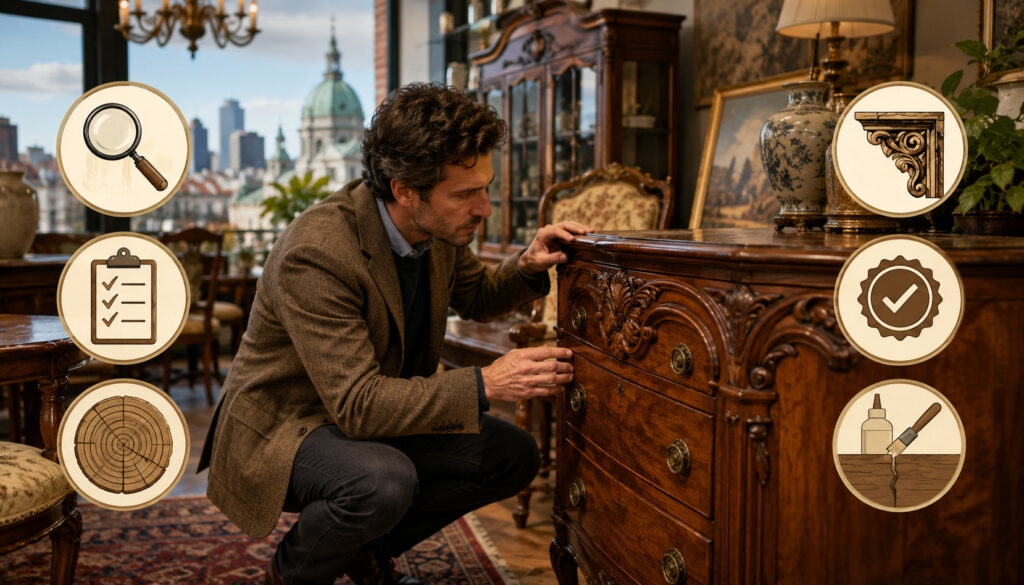
Antique furniture identification Montreal shoppers can use begins with structure rather than finish. Examine how the piece was assembled, which materials were used, whether the hardware is consistent, and how the object has changed.
Look at the back and underside whenever the seller permits it. These areas may reveal unfinished wood, saw marks, replaced panels, modern brackets, extra holes, new screws, reinforcement blocks, or recent staining.
Check whether drawers slide properly and whether the drawer bottoms, sides, and joints appear consistent with the case. Compare the colour and oxidation of exposed wood with protected surfaces.
Consider weight carefully. Solid hardwood furniture may be heavy, but weight alone is not proof of age or quality. Some newer pieces are also substantial, while certain genuine antiques use thin panels, veneers, or lightweight construction.
The guide to collecting antiques on a budget in Montreal offers additional context for setting limits, choosing collecting categories, and comparing shopping channels.
Furniture Inspection Checklist
Begin with the overall shape. Check whether the piece stands squarely or rocks. Look along tabletops and cabinet sides for warping, separation, or repaired splits.
Open every drawer and door. Inspect dovetail joints, drawer runners, bottoms, hinges, locks, escutcheons, and handles. Look beneath handles for extra holes that may indicate replacement hardware.
Examine the feet and lower edges for wear that makes sense. Inspect the backboards and underside for modern plywood, fresh staples, recent brackets, unexplained screws, or new timber.
Study the finish in bright but indirect light. Heavy refinishing may remove old surface character and obscure evidence. A recently applied dark stain can make replacement wood look more consistent than it really is.
Finally, consider function. A beautiful cabinet with unstable joints, mould odour, pest activity, or serious water damage may require work beyond a beginner’s expectations.
Museum-oriented guidance for furniture and wooden objects includes information on finishes, unfinished wood, biological deterioration, and water-related damage.
Furniture Warning Signs
Warning signs do not automatically prove that furniture is a reproduction. They indicate areas that need explanation.
Be cautious when an apparently old piece has perfectly matching new screws, uniform decorative wear, fresh staining inside and outside, identical machine-cut carving, or hardware that covers several unused holes.
Mismatched timbers may indicate an old repair, later reconstruction, or a piece assembled from several objects. Compare the age and wear of drawers, doors, feet, backboards, and decorative elements.
Strong chemical odours may indicate recent refinishing. Musty smells can suggest damp storage, mould, or contaminated upholstery.
Check for structural repairs hidden beneath the piece. Metal plates, modern glue, filler, replacement blocks, and screws may stabilize furniture, but they should be considered when assessing condition.
For large furniture, measure doors, hallways, elevators, stairwells, and the intended room before buying. Authenticity will not solve a transport problem.
How to Inspect Ceramics, Porcelain, Glass, Silver, and Metal
Small decorative objects can appear easier to inspect than furniture, but their marks, repairs, and materials may be difficult to interpret. Ceramics, porcelain, glassware, silver, brass, and bronze each require a different approach.
Handle fragile objects only with permission. Remove rings or loose jewellery that could scratch a surface, and hold pieces with both hands. Do not lift a vessel by its handle, rim, finial, or decorative projection.
Good lighting is essential. Rotate the object slowly and view it from several angles. Side lighting can reveal repaired cracks, overpainting, surface changes, scratches, and differences in gloss.
For metal objects, examine marks before polishing. Tarnish and oxidation may obscure details, but aggressive cleaning can remove surface evidence or damage plating.
Ceramics and Porcelain
Inspect the base first. The foot ring may reveal body colour, kiln marks, glaze boundaries, surface wear, and later grinding. Compare the base with verified examples from the suspected maker or region.
Study the glaze for unevenness, pooling, crazing, staining, and differences around repaired sections. Crazing may occur with age, but it can also appear on newer ceramics and should not be treated as proof.
Check rims, handles, spouts, feet, and decorative projections for chips and restoration. Repaired areas may appear smoother, duller, brighter, or slightly different in colour.
A copied maker mark can look convincing. Compare lettering, spacing, symbols, application method, placement, and relationship to the glaze.
Porcelain may show some translucency under strong light, but this depends on thickness and composition. Avoid using one material test as a final answer.
The government’s ceramics and glass care guidance emphasizes the material characteristics and damage risks of these objects.
Glassware and Crystal
Look for base wear, rim wear, mold seams, bubbles, inclusions, cutting patterns, pontil-related features, and changes in clarity. These clues can help explain how an item was made, but none provides a universal date.
Hand-blown glass may show small irregularities, variations in thickness, or evidence where the pontil was removed. Molded glass may show seams or repeated patterns. Both techniques have long histories, so a seam does not automatically mean an object is recent.
Examine cut decoration under angled light. Hand-cut details may vary slightly and have different edge characteristics from molded patterns, although high-quality modern production can be difficult to judge.
Check rims with a fingertip only when safe and permitted. Tiny chips may be difficult to see. Look for cracks around handles, stems, bases, and thick transitions.
Cloudiness can come from residue, mineral deposits, interior deterioration, or repeated washing. Do not assume it can be cleaned away.
Silver, Brass, Bronze, and Other Metals
Begin with marks. Photograph hallmarks, words, symbols, numbers, and maker stamps. Research each element separately before deciding what the mark means.
Determine whether an object appears to be solid metal, plated, weighted, filled, or assembled from multiple materials. Plating loss may appear on raised edges, handles, feet, or heavily polished areas.
Patina varies by metal and environment. Brass, bronze, copper, iron, silver, and plated surfaces develop different corrosion products. Artificial patination can also be applied intentionally.
Inspect solder joints, seams, casting lines, repairs, cracks, dents, and replaced fittings. Fresh solder or a differently coloured component may indicate restoration.
Excessive polishing can soften engraved details, remove plating, or create uneven colour. Conversely, heavy tarnish does not prove great age.
Authoritative metal-object care information includes resources on corrosion, silver, brass, copper alloys, iron, and metal identification.
How to Inspect Art, Frames, Books, Paper, Clocks, and Lamps
Artwork, books, and functional antiques require special caution because visible appearance may conceal extensive changes. A painting can be old but incorrectly attributed. A book can have an old cover with missing or replaced pages. A working clock can contain a mixture of original and replacement components.
Never remove frames, open mechanisms, dismantle fittings, or test electrical items without permission. A shopper’s role is to observe and ask questions, not perform invasive testing.
For signed, historically significant, expensive, inherited, or potentially rare objects, photographs and casual online opinions are not substitutes for professional examination.
Original Art, Prints, and Frames
Determine whether the image is a painting, drawing, photograph, poster, lithograph, engraving, screen print, digital reproduction, or another print process.
Examine the surface under angled light. Paint may show brushwork, raised texture, cracking, varnish, retouching, or repairs. Printed reproductions may show dot patterns or uniform surface characteristics when viewed with magnification.
Inspect signatures carefully. A signature may be handwritten, printed with the image, copied, added later, or unrelated to the artist commonly associated with the work.
The back can reveal labels, inscriptions, canvas stamps, stretcher construction, framing materials, old repairs, and previous hanging hardware. New backing does not disprove age, but it should not be used as evidence that the artwork is old.
Frames may be older or newer than the art they contain. Never assume the age of one proves the age of the other.
Museum paintings-conservation information illustrates why examination, treatment history, and material understanding matter when assessing artwork.
Books, Maps, Prints, and Ephemera
For books, begin with the title page, publisher information, edition statement, printing details, illustrations, pagination, and binding. The decorative cover alone may not identify the edition.
Check whether all pages, maps, plates, and illustrations are present. Look for library markings, ownership inscriptions, bookplates, replaced endpapers, later bindings, tape, trimming, detached sections, and repairs.
Paper condition matters. Foxing appears as brown spotting, while water exposure can create tide lines, distortion, staining, mould, or stuck pages. Fading and brittleness may indicate light exposure or acidic materials.
Maps, postcards, letters, posters, and other ephemera should be inspected for reproduction processes, cropped margins, missing sections, adhesive residues, and later mounting.
Avoid rubbing, erasing, flattening, cleaning, or removing tape from old paper without suitable knowledge. The paper-object conservation guide explains the risks affecting paper collections and the importance of preventive care.
Clocks, Lamps, and Functional Antiques
A functioning object is not necessarily authentic or original. Clocks may contain replaced movements, dials, hands, pendulums, cases, keys, or decorative elements.
Check whether the movement fits the case properly and whether mounting holes suggest a previous mechanism. Ask about servicing, replaced components, accuracy, and maintenance history.
For lamps, examine the base, socket, switch, cord, plug, shade holder, wiring path, and stability. An antique base may have modern electrical components, which can be positive when the work was completed safely and disclosed.
Do not plug in an old lamp merely because the cord looks intact. Brittle insulation, hidden splices, loose sockets, missing strain relief, and incorrect components can create hazards.
Radios, tools, kitchen devices, and mechanical objects may contain sharp edges, deteriorated insulation, lead-containing finishes, fuel residue, or unstable mechanisms. Have functional antiques inspected by an appropriately qualified professional before regular use.
Authentic Antique Identification Checklist
A written checklist helps shoppers avoid becoming overly influenced by appearance, seller enthusiasm, or the excitement of finding something unusual.
| Checklist Area | What to Inspect | Why It Matters | Priority |
| Category | Furniture, art, ceramics, glass, metal, paper or textile | Determines the correct inspection method | High |
| Materials | Wood, veneer, metal, ceramic, glass, paper or fabric | Reveals manufacturing and aging clues | High |
| Construction | Joinery, seams, hardware, stitching and tool marks | Supports or challenges age claims | High |
| Marks | Labels, stamps, hallmarks, signatures and numbers | Helps identify maker or production context | Medium/High |
| Patina | Wear, fading, oxidation and softened edges | Shows possible handling and use history | High |
| Condition | Cracks, chips, repairs, odours and instability | Affects safety, use and desirability | High |
| Provenance | Receipts, ownership history and documentation | May support the object’s history | Medium/High |
| Restoration | Refinishing, replaced parts, rewiring or repainting | Helps determine originality | High |
| Comparables | Similar verified objects and documented examples | Provides context for description and price | Medium/High |
| Expert review | Qualified appraisal, conservation or specialist input | Important for costly or significant items | High |
How to Use the Checklist
Complete the checklist before paying for a higher-priced object. Begin with the physical item and record what you can observe directly.
Separate facts from claims. “The drawer has irregular dovetails” is an observation. “The chest was handmade in a particular period” is an interpretation that requires additional support.
Photograph the front, back, underside, marks, hardware, condition issues, and any documentation. Include a ruler or measuring tape in selected photographs to show scale.
Record the seller’s wording accurately. Note whether age, maker, originality, restoration, or provenance is confirmed, believed, attributed, or unknown.
Give greater attention to contradictions. If the style appears old but the materials and construction appear recent, pause the purchase. If marks seem promising but condition is heavily restored, research how that restoration affects your goals.
The checklist is especially useful for supposedly rare objects because it directs attention away from promotional language and toward evidence.
Records to Keep After Buying
Keep the receipt, seller description, photographs, measurements, correspondence, research notes, and documentation together. Photograph marks and condition immediately after purchase.
Create a simple record containing:
- Purchase location and date
- Seller’s description
- Materials and dimensions
- Visible marks and labels
- Known repairs or restoration
- Condition at purchase
- Provenance information
- Relevant research sources
- Professional reports or appraisals
- Later conservation or repair work
Records help prevent details from being forgotten. They also make it easier to compare future items, arrange conservation, document insurance needs, or provide accurate information to a qualified appraiser.
Do not alter original labels, inscriptions, packaging, or documentation unnecessarily. Even a damaged label may contain useful information.
Common Mistakes and Best Practices for Montreal Antique Shoppers
The most common mistakes are usually caused by speed, assumptions, and overconfidence. Beginners may trust a seller’s description without asking for support, treat every maker mark as genuine, or assume an old object must be financially valuable.
Other shoppers focus on authenticity while overlooking condition, transport, safety, usefulness, or restoration costs. An item can be authentic and still be unsuitable for the buyer’s home or collection.
The best antique buying tips Montreal shoppers can follow are based on patience. Inspect first, record evidence, compare examples, and seek expert input when the financial or historical significance justifies it.
A beginner’s guide to bric-à-brac shopping can also help new shoppers become comfortable comparing objects without feeling pressured to buy every interesting piece.
Mistakes to Avoid
Avoid these frequent errors:
- Believing every antique claim without supporting evidence
- Assuming age automatically creates value
- Judging authenticity from a single maker mark
- Ignoring cracks, instability, mould, pests, odours, or unsafe wiring
- Overlooking replaced handles, screws, backing, upholstery, or movements
- Confusing artificial distressing with natural patina
- Comparing asking prices instead of genuinely similar examples
- Buying under pressure because an item is described as rare
- Cleaning, polishing, or refinishing before understanding the material
- Purchasing large furniture without measuring access points
- Treating a seller’s informal opinion as a professional appraisal
- Spending heavily in an unfamiliar category
A replaced component does not necessarily make an object undesirable. The mistake is failing to recognize or account for the change.
Ask direct questions and request clarification when descriptions are vague. A careful seller should be able to distinguish documented facts from personal beliefs.
Build Knowledge and a Research Routine
Beginners should start with lower-risk objects and a narrow collecting category. Studying one area—such as small brass items, local prints, ceramics, glassware, or functional furniture—builds pattern recognition faster than trying to master every category at once.
Visit different Montreal vintage shops and markets without always planning to buy. Compare weight, marks, materials, prices, wear, and construction.
Create a repeatable routine:
- Identify the category.
- Examine materials and construction.
- Photograph marks and condition.
- Ask about provenance and restoration.
- Compare verified examples.
- Record unanswered questions.
- Decide whether professional review is justified.
Buy objects you genuinely like and can use, display, preserve, or study. An item does not need to be highly valuable to be a satisfying purchase.
Knowledge develops gradually. Every careful inspection improves the next one.
When to Seek Professional Appraisal and How to Make a Final Decision
General inspection can help shoppers identify obvious inconsistencies, condition concerns, and research questions. It cannot replace specialist evaluation for rare, expensive, historic, insured, inherited, or potentially significant objects.
Professional review may be appropriate for important artwork, signed objects, fine silver, jewellery, unusual ceramics, early furniture, historic documents, estate collections, and objects requiring insurance or formal documentation.
Choose a professional with relevant category knowledge. A specialist in paintings may not be the right person for clocks, books, furniture, or ceramics.
Appraisal vs. Casual Opinion
A casual opinion is an informal reaction based on limited information. It may be useful as a starting point, but it normally does not include complete inspection, documented methodology, market analysis, or a formal written conclusion.
A professional appraisal is a structured service completed for a defined purpose. The appraiser may inspect materials, dimensions, marks, condition, provenance, comparable evidence, and relevant markets.
Bring clear photographs, measurements, receipts, seller descriptions, ownership history, restoration records, certificates, and previous reports. Do not hide damage or repairs, since these details are necessary for an informed review.
For museum-level objects or difficult attributions, additional specialists may be needed. Conservators, curators, historians, scientists, and category experts can answer different questions.
The safest approach is to seek appropriate professional help before making a major financial decision rather than relying on an informal opinion afterward.
The Five-Question Antique Buying Test
Before buying, ask:
- Is the item well made?
Examine materials, construction, stability, and craftsmanship. - Are the age clues consistent?
Consider whether the marks, hardware, patina, style, and wear support the same story. - Is the condition acceptable for my purpose?
Decide whether repairs, missing parts, odours, damage, or safety concerns are manageable. - Is the price supported by useful research?
Compare genuinely similar items rather than broad category listings. - Would I still want it if it were not highly valuable?
Personal enjoyment, usefulness, design, and historical interest may be more dependable than speculative expectations.
Walk away when the seller creates pressure, refuses reasonable inspection, cannot explain important contradictions, or makes strong claims without evidence. Also reconsider objects with severe structural damage, unsafe components, suspicious marks, major undisclosed restoration, or unsupported prices.
Leaving without buying is not a missed opportunity. It is part of responsible antique buying.
Frequently Asked Questions
How can I identify authentic antiques in Montreal?
Start by identifying the item category and examining its materials, construction, marks, patina, condition, and repairs. Look at hidden areas such as furniture undersides, ceramic bases, frame backs, book title pages, and clock movements.
Ask about provenance and restoration, then compare the object with verified examples. Avoid relying on one feature or seller statement.
For expensive, rare, historic, inherited, or potentially valuable items, seek evaluation from a qualified professional with experience in that category.
What are the easiest antique identification clues for beginners?
Useful beginner clues include material quality, joinery, hardware, maker marks, natural wear, repairs, and construction differences between exposed and protected areas.
Beginners can also check whether wear makes sense for the item’s use. Handles, feet, seats, rims, hinges, and other frequently touched areas should normally show different wear from protected surfaces.
These clues do not prove age individually, but they help shoppers identify which objects deserve further research.
How do I know whether an item is an antique or a reproduction?
Compare the object’s materials, construction, hardware, finish, marks, and wear. A reproduction may show modern materials, uniform machining, artificial distressing, fresh labels, or wear applied decoratively rather than through normal use.
However, high-quality reproductions can be convincing, while genuine antiques may contain newer repairs. The most dependable conclusion comes from several consistent clues, reliable documentation, comparable verified examples, and expert evaluation when necessary.
What should I check before buying antique furniture?
Inspect stability, joints, drawers, legs, feet, backboards, underside, hardware, finish, odours, pest evidence, water damage, warping, veneer loss, and structural repairs.
Check whether handles fit the original holes and whether modern reinforcement has been added. Measure the piece and every doorway, staircase, hallway, and elevator involved in transport.
Do not assume that heavy weight, dark wood, dovetails, or old hardware alone proves authenticity.
Are maker marks enough to prove authenticity?
No. Marks can be copied, misunderstood, transferred, added later, or used across long production periods.
Research the exact shape, lettering, placement, application method, and relationship between the mark and the surrounding material. Compare it with verified examples from reliable references.
A convincing mark should agree with the object’s materials, construction, style, condition, and known manufacturing history.
How important is condition when buying antiques?
Condition is important because it affects safety, usability, appearance, originality, preservation needs, and market interest.
Expected wear can contribute character, but severe cracks, unstable joints, active corrosion, mould, pests, water damage, missing parts, or unsafe wiring may require professional attention.
The importance of a condition issue depends on the item and the buyer’s purpose. A decorative object and a functional chair may require very different standards.
When should I get a professional antique appraisal?
Consider professional appraisal for expensive purchases, inherited collections, insured objects, estate planning, suspected rare items, important artwork, jewellery, fine silver, historic documents, and objects intended for significant resale decisions.
Professional input is also useful when physical clues conflict, provenance is complicated, or restoration makes originality difficult to evaluate. Choose an appraiser with demonstrated experience in the relevant category.
Conclusion
Learning how to identify authentic antiques in Montreal requires patience, observation, research, and a willingness to leave questions unanswered until stronger evidence becomes available.
Begin with the item category. Examine materials, craftsmanship, joinery, hardware, marks, labels, hallmarks, signatures, patina, and wear. Check condition carefully and ask about provenance, restoration, replaced parts, and previous appraisals.
Compare the object with verified examples rather than relying on appearance or broad online listings. Remember that natural wear should correspond with the way an item was handled and used.
Authentic antique identification is almost never based on one clue. A maker mark, dovetail joint, dark finish, signature, family story, or worn surface may be meaningful, but it must fit the rest of the evidence.
Reproductions and restored objects can still be attractive, useful, and enjoyable when they are accurately described. Responsible antique buying is not about rejecting every imperfect or altered item. It is about understanding what you are purchasing and deciding whether it suits your purpose.
For rare, expensive, historic, inherited, insured, or potentially valuable objects, professional appraisal or specialist review remains the safest approach. Careful inspection can improve confidence, but expert evaluation provides the deeper category knowledge required when the consequences of a mistake are significant.