
By Devin Jones September 5, 2026
Montreal’s secondhand shopping scene can move from a polished antique shop with a countertop terminal to a temporary market table where the seller expects cash. That makes the Montreal flea market cash or card question less about choosing one payment method and more about arriving prepared for several kinds of transactions.
For most shoppers, the practical answer is to carry both cash and a card. Established antique stores and vintage boutiques are more likely to offer debit, credit, Interac or contactless payment, while occasional vendors and some small flea-market stalls may rely on cash or other payment arrangements. Acceptance can differ even between neighbouring sellers at the same event.
Taxes require a separate distinction. Secondhand merchandise is not automatically tax-free because it is old, vintage or previously owned. Revenu Québec states that used property sold in the course of commercial activities is generally taxable at 5% GST and 9.975% QST.
An antique dealer that is registered for the taxes must therefore generally collect them on taxable used goods. By contrast, an individual selling personal belongings outside commercial activities—for example at a garage sale—is treated differently.
Cash can occasionally help a negotiation, but it does not guarantee a better price and it does not erase taxes that legally apply.
This guide concentrates on that transaction side of Montreal antique and flea-market shopping: payment methods, bargaining, tax, tap limits, ATM planning, receipts, provenance, returns and higher-value purchases.
Informational note: Tax, payment-network and consumer-protection rules can depend on the seller, transaction and circumstances. This guide provides general shopping information rather than individualized tax or legal advice.
Cash or Card at Montreal Flea Markets: What to Expect
If you are deciding between Montreal flea market cash or card, think first about the type of seller rather than the type of merchandise.
A permanent vintage store selling a $400 mid-century chair operates differently from somebody selling dishes, books and household items from a temporary table. A professional antique dealer who participates in several markets may carry a mobile card reader. A private seller clearing personal belongings may have no commercial payment equipment whatsoever.
That is why two stalls twenty feet apart can have entirely different payment policies.
Cash remains widely useful because it requires no terminal, payment account, battery, mobile connection or authorization. Debit and credit cards become more practical as sellers become more established and transaction sizes increase.
Mobile POS technology has also made card acceptance possible without a traditional countertop terminal: Interac confirms that Canadian businesses can accept contactless payments through supported mobile-device solutions as well as conventional POS terminals.
Mobile wallets such as Apple Pay or Google Pay may work when the merchant’s terminal and processor support the relevant contactless transaction. Their availability should not be assumed merely because the seller accepts one type of card.
Cash vs. Card by Seller Type
| Seller Type | Cash | Debit/Card | Tap | What Buyer Should Expect |
| Established antique shop | Commonly usable | Often available | Often available where supported | Ask about tax and return terms before paying |
| Vintage boutique | Commonly usable | Often available | Frequently possible with equipped POS | Similar payment experience to other specialty retail |
| Professional market dealer | Common | May be available | May be available through mobile reader | Payment methods can vary by event or setup |
| Small independent stall | Often useful | Sometimes available | Depends on equipment and connectivity | Confirm before building a bundle |
| Temporary pop-up vendor | Often accepted | May use mobile POS | Possible where supported | Infrastructure varies considerably |
| Occasional seller | Often preferred | Less predictable | Less predictable | Ask before assuming electronic payment |
| Private individual | Often practical | Commercial card acceptance less likely | Not something to assume | Payment arrangements may be informal |
These are tendencies rather than promises. A permanent shop can be temporarily unable to process cards, and an outdoor vendor can arrive with a modern phone-based payment setup.
If you want broader guidance on evaluating the merchandise itself, the site’s guide to finding hidden bric-à-brac treasures in Mont-Royal covers condition, research, pricing and inspection without duplicating the payment questions addressed here.
Which Antique and Vintage Sellers Usually Accept Cards?
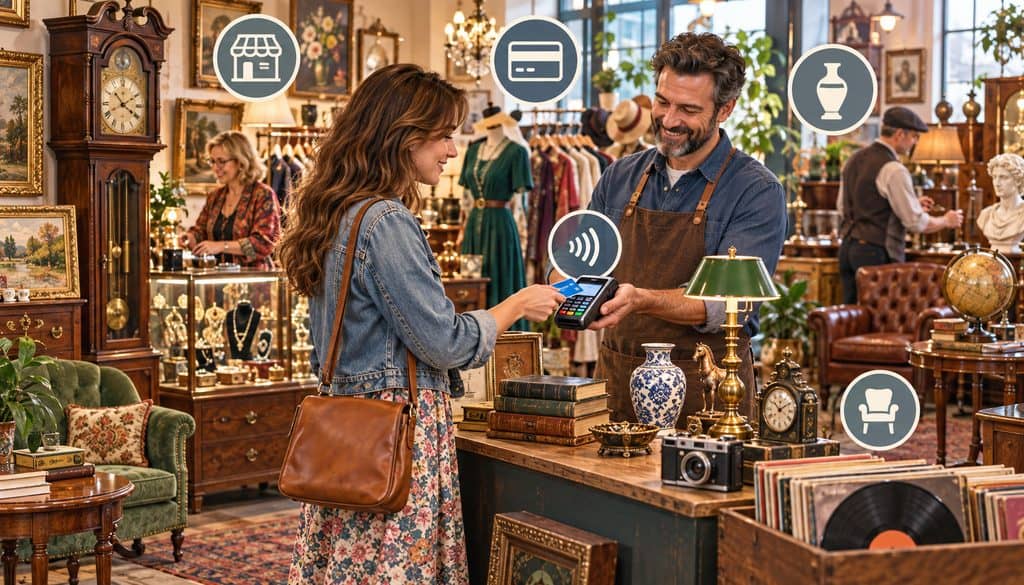
The strongest tendency with card payments vintage stores is straightforward: the more consistently a seller operates as a retail business, the more useful electronic payments become.
An established antique shop may need to accept purchases ranging from inexpensive tableware to four-figure furniture or artwork. Maintaining a POS system lets customers use debit, credit and sometimes mobile wallets without arriving with substantial cash.
Professional market dealers can also accept electronic payments. Modern mobile processing means a dealer does not necessarily need a conventional cash register. Interac documents options for accepting debit through terminals and supported mobile devices, including Tap to Pay technology.
Small and occasional sellers have a different calculation. Acceptance can depend on processing costs, internet or mobile connectivity, expected transaction volume, battery life, the seller’s commercial setup and whether the event provides useful infrastructure.
A dealer may also consider payment disputes and settlement logistics. Cash is immediately final as a payment medium, whereas card sales travel through payment-processing systems and can later become subject to disputes under applicable issuer and network processes.
From the buyer’s side, none of this means you should predict payment acceptance from appearances. A polished-looking stall may be cash-only that day. A folding table in an outdoor market may have a smartphone capable of accepting contactless cards.
Ask.
That becomes especially important when buying furniture, multiple collectibles or another purchase too large to cover comfortably with the cash you brought.
For shoppers trying to distinguish genuine age, quality and seller claims before reaching the checkout stage, the site’s guide to identifying authentic antiques in Montreal is a useful companion resource.
Why Cash Still Helps at Flea Markets
Cash remains useful at flea markets because it solves several small transaction problems at once.
A $5 book, $12 vase or handful of inexpensive postcards does not require a network connection when you have the right bills. Cash also works when a seller’s mobile reader cannot connect, a device battery fails or electronic acceptance simply is not offered.
It can be useful for bundle negotiation as well. If three items are individually marked $18, $15 and $12, proposing one clear amount for all three is easy when you can immediately complete the transaction. The convenience may matter to a seller, but it does not mean the seller owes you a discount.
Nor should a shopper interpret “cash preferred” as “tax disappears.” If a registered business is required to collect GST and QST on the sale, payment in banknotes does not change the tax status.
A sensible market-day cash setup is more useful than carrying a large stack of high-denomination bills. Divide what you intend to spend into:
- small bills for low-cost objects and near-exact payment;
- medium denominations for common purchases and bundles;
- a limited backup amount for a seller that cannot take your card.
How much that means depends on your budget. Someone browsing records and kitchenware has different needs from a collector hoping to purchase furniture. There is no responsible universal dollar amount.
Keep cash in more than one secure place rather than repeatedly displaying your entire market-day budget.
For broader spending discipline, see the site’s guide to shopping bric-à-brac on a budget without overpaying.
How GST and QST Apply to Secondhand Goods
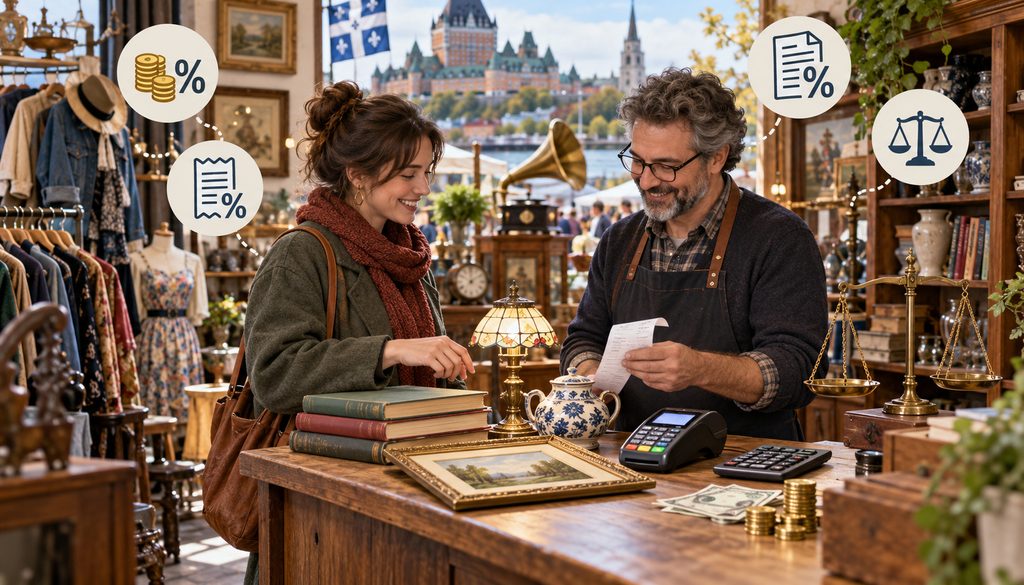
The phrase GST QST secondhand goods often creates confusion because shoppers naturally associate sales tax with new retail merchandise. Quebec tax rules do not create a general exemption merely because an object has had a previous owner.
Revenu Québec’s current guidance is explicit: as a rule, used property sold in commercial activities is taxable at 5% GST and 9.975% QST. It specifically notes that a registrant antique dealer must generally collect GST/HST and QST on property sold.
The QST is calculated on the selling price excluding GST. Consequently, applying 5% GST and 9.975% QST to the same pre-tax sale amount gives shoppers an effective combined addition of 14.975% on an ordinary fully taxable Quebec sale.
Revenu Québec’s general rules confirm both current rates: 5% GST and 9.975% QST.
So the key question in understanding tax on used items Quebec is not, “Has someone owned this before?”
It is more often, “Who is selling it, is this a taxable commercial supply, and is the seller required or registered to collect the taxes?”
Registered Dealers
A registered antique dealer making an ordinary taxable sale generally collects GST and QST even when the merchandise is decades old.
That can include antique furniture, vintage clothing, collectible objects, decorative pieces, records, jewelry and other used merchandise, subject to any specific rule that might apply to the particular property.
For shoppers, this means a $100 tag at a registered shop should not automatically be read as $100 out the door.
Quebec’s consumer-protection guidance says advertised prices generally must represent the total required merchant price, but GST and QST are among the amounts that can be excluded from the advertised price and added at checkout.
You can review the official Revenu Québec guidance for used property and its basic GST/QST rules for the underlying tax treatment.
Small Suppliers
Registration status matters too.
Revenu Québec currently describes a small supplier, in the usual case, as a person whose qualifying worldwide taxable supplies together with those of associates do not exceed $30,000 over the relevant calendar-quarter tests.
A small supplier generally does not have to register for or collect GST/HST and QST, although voluntary registration can be possible. The timing changes if the threshold is exceeded, including immediate consequences when it is exceeded in a single quarter.
CRA likewise confirms the $30,000 small-supplier threshold for most businesses and explains that registration timing depends on how the threshold is crossed.
That is why shoppers should avoid making assumptions based solely on whether a booth “looks like a business.” Registration and tax obligations depend on the seller’s circumstances.
Private Sellers
A genuine private sale can be different.
Revenu Québec specifically states that used property is not taxable when sold by a person who is not engaged in commercial activities, giving the example of an individual selling personal items at a garage sale.
That supports an important distinction: somebody occasionally selling personal belongings is not automatically equivalent to a professional antique dealer.
But neither the physical location nor the word “flea market” determines the result. Revenu Québec expressly states that people occupying space at a flea market are subject to the same rules as most other merchants regardless of whether what they sell is new or used.
A seller conducting an actual commercial activity therefore cannot become a non-commercial private seller simply by putting merchandise on a flea-market table.
GST/QST on Secondhand Goods
| Seller Type | Tax May Apply? | Receipt | What Buyer Should Ask |
| GST/QST-registered antique dealer | Generally yes on ordinary taxable used goods | Formal receipt should be expected as normal business practice | “Is tax included in that price?” |
| Registered vintage retailer | Generally yes on taxable merchandise | Usually formal | Confirm quoted price plus applicable taxes |
| Commercial flea-market dealer | Same general tax principles as other merchants | May range from POS receipt to written invoice | Ask whether GST/QST applies |
| Qualifying small supplier not registered | May not be required to collect GST/QST | Documentation practices vary | Ask whether taxes are being charged |
| Individual disposing of personal property outside commercial activity | Revenu Québec says such used-property sales are not taxable | May be informal | Keep basic proof for valuable items |
| Seller whose status is unclear | Cannot determine from appearance alone | Varies | Clarify before paying |
There are specialized exceptions and rules for particular property—for example, Revenu Québec notes separate QST treatment for certain road vehicles. An ordinary antique-shopping guide should not extrapolate from those specialized cases.
Is Tax Added After You Haggle?
Yes, when GST and QST apply, negotiating the merchandise price does not make the taxes disappear.
Quebec’s current price-display rules permit GST and QST to be excluded from the advertised sale price and added at payment.
Suppose an antique is marked:
Marked price: $100
You inspect it, notice some condition issues and negotiate:
Agreed selling price: $85
If the transaction is an ordinary taxable sale to which both current Quebec taxes apply, the taxes are calculated from the applicable selling price:
- GST at 5% on $85 = $4.25
- QST at 9.975% on $85 = $8.48 after normal currency rounding
- total approximately $97.73
The important conversation therefore happens before payment:
“Is $85 before tax or tax included?”
That question matters because bargaining often happens verbally. One person may hear “I can do $85” and assume that is the final amount, while the registered dealer means an $85 selling price plus applicable tax.
Does Paying Cash Get You a Better Price?
Sometimes cash can make a transaction easier. It does not create an entitlement to a discount.
The relationship between cash and haggling antique shops Montreal depends on seller type, item value, margin, condition, demand and store policy.
An occasional seller who wants to pack up at the end of the day may accept a reasonable cash offer. A professional dealer might negotiate when you buy three items. An established boutique may have fixed prices regardless of payment method.
Cash can be attractive operationally because a transaction can be completed immediately without electronic authorization. But using processing cost as a reason to pressure a dealer is rarely necessary or productive.
Haggling by Payment Method
| Scenario | Cash Advantage? | Card Still Fine? | Suggested Approach |
| Several inexpensive items | Sometimes convenient | Yes, if accepted | Ask for a reasonable bundle price |
| Single low-cost object | Usually little bargaining leverage | Yes | Avoid negotiating over trivial amounts |
| Item with visible repair need | Payment method is secondary | Yes | Mention the condition respectfully |
| Higher-priced antique | Cash is not automatically preferable | Often useful | Agree on price, tax, receipt and terms |
| Fixed-price boutique | Usually none | Yes | Respect stated pricing |
| End-of-day informal stall | Seller may be more flexible | Possibly | Ask rather than assume |
| Consignment item | Often limited | Usually | Seller may not control the price |
The crucial distinction is this:
A cash discount and tax avoidance are not the same thing.
A dealer can agree to sell an item for less. Where GST and QST legally apply, however, paying the reduced amount in cash does not turn a taxable commercial sale into a tax-free sale.
That boundary protects both buyer and seller. There is nothing wrong with respectful negotiation; there is a problem with treating unrecorded cash as a way to sidestep legally required tax.
How to Haggle Politely in Montreal Antique Shops

Good antique-market negotiation starts with a question, not a demand.
You are trying to discover whether the seller has flexibility, not prove that their price is wrong.
Useful phrases include:
- “Is there any flexibility on the price?”
- “Would you take $___?”
- “Is that your best price if I take both?”
- “Would you consider $___ given the repair it needs?”
A little French can also make the interaction comfortable where appropriate:
- “Est-ce que vous êtes flexible sur le prix ?”
- “Si j’en prends deux, pourriez-vous faire un meilleur prix ?”
Bundle buying is often the most natural reason to ask. If you genuinely want three items, one reasonable combined offer can be easier for everyone than negotiating separately over each object.
Condition is another valid basis. A chipped rim, replacement hardware or required furniture repair can inform an offer, provided you mention the issue accurately rather than manufacturing defects to force down the price.
Late-day timing can sometimes influence an informal seller who would rather sell than repack merchandise. It is a possibility, not a local rule or guaranteed strategy.
The site’s existing advice on finding hidden treasures in Mont-Royal similarly recommends asking rather than demanding and accepting “no” without argument.
When Haggling Is Less Appropriate
Not every secondhand purchase is an invitation to bargain.
Exercise more restraint when:
- prices are clearly fixed;
- the shop operates under a stated no-negotiation policy;
- the piece is already substantially discounted;
- an item is inexpensive enough that the proposed reduction is trivial;
- merchandise is on consignment and the employee cannot alter the owner’s price;
- proceeds support a charity and the sale is not set up for bargaining;
- the product is artist-made rather than ordinary resale inventory.
The most useful flea market payment tips are often social rather than financial: ask once, make a credible offer and accept the answer.
For a deeper inspection routine, the site’s guide to avoiding common bric-à-brac shopping mistakes in Montreal complements this payment-focused guide.
Tap Limits and Small-Dealer Card Minimums
A contactless symbol on a terminal does not mean every transaction can be completed with a tap.
Interac currently says contactless transaction limits are set by financial institutions and are typically around $250, while emphasizing that the limit can vary. It also describes cumulative contactless spending limits that may trigger a requirement to insert the card and enter a PIN.
That makes “$250 is the tap limit in Montreal” an inaccurate rule.
The practical lesson is simpler: do not rely on tap alone for an expensive purchase.
A larger purchase—or a transaction affected by your issuer’s security controls—may require another verification method. A mobile wallet can behave differently because device authentication and issuer/network policies may affect the transaction, but it should not be assumed to provide an unlimited contactless ceiling.
Interac’s current contactless payment guidance is the better source for current Canadian debit behaviour.
What About Card Minimums?
You may encounter a small seller who says cards are accepted only above a certain purchase amount. Do not assume that means a particular dollar minimum is standard across Montreal.
Network rules matter.
Visa Canada’s current consumer-support information states that, in general, a merchant may not establish a minimum or maximum amount for accepting Visa. The exceptions Visa describes for minimum credit-card amounts concern the United States and U.S. territories, not a general Canadian minimum rule.
Mastercard’s published rules likewise contain a general prohibition on requiring minimum or maximum transaction amounts, subject to regional modifications.
Because card brand, payment product, acquiring agreement and transaction circumstances can matter, a shopper should not try to resolve a network-contract dispute at a flea-market table. Ask what the seller accepts before committing to the purchase and use another available payment method if that is convenient.
ATM and Change Strategy for a Market Day
A little preparation can eliminate most flea-market ATM frustration.
If you expect to use cash, withdrawing it from a bank or ATM you understand before entering a market is usually easier than assuming an ATM will be available exactly when you need one.
Do not plan around a particular Montreal ATM fee unless you have checked your bank and the machine being used. Charges can vary by ATM operator, account, network and bank.
International visitors should check even more carefully. Your own financial institution may impose foreign ATM or foreign-transaction fees, and the ATM operator may impose its own charge.
When a terminal or ATM offers to convert a Canadian-dollar transaction into your home currency—a practice commonly called dynamic currency conversion—compare the terms rather than assuming conversion at the machine is advantageous. Exchange-rate and fee structures differ between providers and cards.
Build a Useful Change Mix
Cash becomes far more convenient when the denominations match the purchases you are making.
Sellers, particularly at the beginning of a market day, may have limited change. Handing over a high-denomination note for a very small item can create an unnecessary problem.
Try to maintain:
- small bills for low-cost finds;
- enough mid-sized bills for ordinary purchases;
- limited larger denominations rather than relying entirely on them.
If a seller quotes $18 and you already intended to pay that amount, handing over something close to $18 is faster than asking them to break a much larger note.
Keep cards accessible but cash discreet. There is rarely a reason to pull your entire budget out while negotiating.
Why You Should Ask for a Receipt
The importance of a receipt increases with the financial, collectible or historical importance of what you buy.
For an inexpensive secondhand mug, a detailed provenance file would be excessive. For a $1,500 painting, antique ring or designer vintage bag, payment documentation can become essential.
Ask for a useful receipt or invoice when buying:
- expensive antiques;
- art;
- jewelry;
- furniture;
- important collectibles;
- branded or designer vintage goods;
- items represented with specific historical or maker claims;
- merchandise carrying return or warranty terms.
A useful receipt ideally identifies:
- seller or business;
- transaction date;
- item description;
- amount paid;
- GST/QST charged where applicable;
- payment method;
- agreed return or final-sale terms where relevant.
Documentation standards can differ with private sellers, and this guide does not suggest that every casual private transaction creates the same invoicing obligations as a retail business.
For a valuable private purchase, however, even a basic written record identifying the parties, item, date and amount can be more useful later than having no transaction record at all.
Provenance and Valuable Antiques
A receipt proves considerably less than many buyers imagine.
It can establish that you acquired a described object from a particular seller at a particular time for a particular amount. It does not, by itself, establish that a painting is genuine, a chair was made by the attributed designer or a piece of jewelry comes from the claimed period.
Provenance means the documented history of an object’s ownership or custody. Depending on the piece, useful material can include:
- previous invoices;
- auction records;
- estate records;
- certificates;
- exhibition records;
- maker documentation;
- labels and serial numbers;
- photographs;
- written seller representations.
Preserve originals where practical and photograph documents as backups.
This becomes particularly important if the piece is later appraised, insured, resold or included in an estate inventory.
For furniture, the site’s detailed guide to spotting antique furniture in Mont-Royal explains construction, materials, maker marks and condition clues that should be considered separately from payment documentation.
Returns: Paying by Card Does Not Create a General Return Right
Do not assume that paying by credit card gives you an automatic right to return an antique because you changed your mind.
Quebec’s Office de la protection du consommateur says merchants are not generally required to refund, exchange or issue a credit for a non-defective item merely because the consumer no longer wants it. Merchants can establish their own exchange and refund policies and must follow the policy they adopt.
Other legal protections can apply when goods are defective or do not conform to applicable representations or legal warranties, so “final sale” should not be interpreted as eliminating every possible consumer right.
Before buying an antique or vintage piece from a merchant, ask:
- Is this final sale?
- Are exchanges permitted?
- Is there a return window?
- Are there condition-related exclusions?
- Can the policy be written on the receipt?
The official Quebec consumer-protection guidance on refunds and exchanges provides the applicable consumer guidance.
Customs and Taking Antiques Home
Visitors leaving Canada should keep receipts because their destination country’s customs authorities may require purchase values when goods are declared. Duty, tax, exemptions and reporting requirements depend on the destination jurisdiction.
There is also a Canadian issue for certain significant objects.
Canada controls the export of specified cultural property. Canadian Heritage explains that items meeting the categories, age, creator-status and value requirements in the Canadian Cultural Property Export Control List may require an export permit.
The regime can include fine art, decorative arts, archaeological material, historical objects, scientific objects, archival material and musical instruments.
Being “an antique” does not automatically mean an export permit is required, nor does being 50 years old alone establish that one is necessary. The full Control List criteria matter.
For potentially significant pieces, review the official Canadian cultural property export guidance before travel.
Objects made from restricted wildlife materials can raise separate rules, so buyers of unusual ivory, shell, taxidermy or similar materials should investigate applicable requirements rather than relying only on the seller’s assurances.
What Card Acceptance Gives Buyers
Accepting cards is often discussed from the merchant’s perspective—processing costs, equipment and settlement—but it can materially improve the buyer’s experience.
For shoppers, card acceptance can mean:
- carrying less cash;
- being able to complete a larger planned purchase;
- having a transaction visible on a financial statement;
- easier expense documentation for professional buyers or decorators;
- contactless and mobile-wallet convenience;
- access to whatever protections the particular issuer, card product and applicable rules provide.
It can also make an unexpected find feasible. Someone who visits intending to buy small décor may unexpectedly discover the right antique cabinet. Being able to pay electronically avoids the security and logistical problem of finding a large quantity of cash.
Card Protection Does Not Equal a Guaranteed Refund
The existence of card dispute procedures does not mean “pay by credit card and you can always charge it back.”
Quebec’s consumer-protection rules provide specific chargeback rights in certain contexts, notably qualifying distance transactions such as certain online purchases where statutory cancellation requirements are met. Those rules should not be generalized into an unconditional chargeback right for every in-person antique purchase.
Issuer and network dispute processes also depend on the facts.
Antiques can create especially complicated “not as described” disagreements because age, condition, repairs, attribution and authenticity may be disputed. Your strongest protection is still to inspect the object carefully, obtain important representations in writing and retain documentation.
A card transaction record can demonstrate that payment occurred. It cannot prove that a vase was produced in 1910.
Cash vs. Card for High-Value Purchases
As purchase value rises, traceability and documentation become more important than the convenience of shaving seconds off checkout.
Before paying substantially more than you normally would for a secondhand object:
- Identify the seller. Know whether you are dealing with an established business, professional dealer or private individual.
- Inspect condition carefully. Photograph damage, restoration and important marks.
- Clarify the agreed selling price. Confirm whether tax is included.
- Ask how GST/QST is being handled. This is especially important when the seller is operating commercially.
- Ask for provenance supporting important claims.
- Confirm the return or final-sale policy.
- Get a detailed receipt or purchase record.
- Use a traceable payment method where practical.
- Do not let another buyer’s interest rush you past verification.
Valuable Purchase Checklist
| Item to Verify | Why It Matters | Record to Keep |
| Seller identity | Provides transaction traceability | Business receipt/contact information |
| Item description | Identifies what was actually sold | Invoice and photographs |
| Condition | Helps document known damage or restoration | Close-up photographs |
| Maker/attribution | May influence value | Written representation and supporting records |
| Provenance | Supports ownership history | Prior invoices/certificates |
| Negotiated price | Prevents disagreement | Receipt or written agreement |
| GST/QST | Documents total transaction | Itemized receipt |
| Return terms | Avoids assumptions after purchase | Written policy |
| Payment | Shows transaction occurred | Card record or written cash receipt |
| Export documentation | May matter for controlled cultural property | Permits and invoices where applicable |
For shoppers focused on less expensive finds, the site’s 2026 guide to affordable vintage finds in Montreal can handle the “where and what to browse” side while this guide covers how to transact.
Buying From Private Sellers vs. Established Antique Shops
The distinction affects much more than tax.
A private individual selling household possessions may have no card terminal, formal receipt printer, standardized condition description or written return procedure. That does not make the transaction inherently bad; it means the buyer may need to create more of the documentation.
A professional antique shop is more likely to maintain business infrastructure such as payment acceptance, tax records, receipts and written policies. Yet “more likely” should never become “always.” Individual shops determine their payment setup, and registration status should not be guessed from decor or location.
| Payment Method | Best For | Main Benefit | Main Limitation |
| Cash | Small purchases, cash-oriented sellers | Works without POS connectivity | Less transaction traceability |
| Debit/Interac | Everyday purchases where accepted | Direct electronic payment | Terminal/issuer controls apply |
| Credit card | Larger purchases where accepted | Transaction record and card-account convenience | Acceptance and dispute outcomes vary |
| Contactless/tap | Fast compatible transactions | Quick checkout | Transaction/cumulative limits can apply |
| Mobile wallet | Compatible contactless terminals | Device-authenticated convenience | Seller and terminal must support it |
| Backup card | Failed primary payment | Redundancy | Still depends on merchant acceptance |
Common Flea Market Payment Mistakes
Most payment mistakes happen because shoppers assume that every seller operates the same way.
They do not.
Common Payment Mistakes
| Mistake | Why It Causes Problems | Better Approach |
| Arriving with no cash | Some sellers may not take cards | Carry a reasonable amount plus cards |
| Carrying only large bills | Seller may have limited change | Bring smaller denominations |
| Assuming every stall takes tap | Equipment and connectivity vary | Ask before negotiating |
| Assuming $250 is a universal tap rule | Issuer and terminal limits vary | Be prepared to insert card or use another method |
| Forgetting GST/QST | Taxable dealer purchase may cost more than the tag | Budget for applicable taxes |
| Not clarifying negotiated price | “$85” can mean before tax or total | Confirm explicitly |
| Assuming cash means no tax | Payment method does not determine tax status | Separate negotiation from tax |
| Treating every seller as a private seller | Commercial vendors follow commercial tax rules | Consider seller status |
| Assuming every used item is tax-free | Used commercial goods can be taxable | Ask whether GST/QST applies |
| Relying on a single card | Card, issuer or terminal problems happen | Bring backup payment |
| Using an ATM without checking charges | Fees vary | Check your bank/operator terms |
| Skipping the receipt | Weakens transaction documentation | Request one for meaningful purchases |
| Treating a receipt as authentication | Receipt proves a transaction, not necessarily authenticity | Request supporting provenance |
| Assuming card means automatic returns | Return rights do not arise merely from card use | Ask about policy before purchase |
| Buying expensive antiques under pressure | Condition or documentation gets overlooked | Inspect and document before paying |
The best defense is not complicated: identify the seller type, understand the total price, inspect the item, know the payment options and preserve better records as the purchase becomes more valuable.
Montreal Flea Market Payment Checklist
Before heading out, use this checklist:
- Carry both cash and card.
- Carry useful small denominations.
- Keep part of your cash as a backup rather than spending it immediately.
- Bring a backup card where practical.
- Keep your phone available for a supported mobile wallet if you use one.
- Confirm payment method before negotiating a large bundle.
- Ask whether an agreed price is before tax or tax included.
- Distinguish a commercial dealer from a genuine private sale where tax treatment matters.
- Remember that secondhand merchandise is not automatically tax-free.
- Do not assume cash removes GST/QST.
- Haggle respectfully and accept a firm price.
- Do not rely on a universal tap limit.
- Check your own ATM and foreign-transaction fees before travelling.
- Ask for a useful receipt for valuable purchases.
- Keep provenance, certificates and prior invoices.
- Photograph high-value items and identifying marks.
- Confirm final-sale, exchange and return terms before paying.
- Use a traceable payment method where practical for significant purchases.
- Check export or destination-country requirements for unusual or valuable antiques.
Frequently Asked Questions
Should I bring cash to Montreal flea markets?
Yes, bringing some cash is practical because payment acceptance varies and some smaller or occasional sellers may not accept cards. There is no need to carry an excessive amount; combine useful small bills with a card and backup payment method.
Do Montreal antique shops take credit cards?
Many established antique shops and vintage businesses have electronic payment systems, but acceptance should not be assumed at every business. Ask before making a large purchase if card payment is important to you.
Can I use a tap at flea-market stalls?
Sometimes. Vendors using compatible terminals or mobile POS equipment may accept contactless payments. Interac confirms that contactless acceptance can work through conventional terminals and supported mobile devices.
Are used goods taxed in Quebec?
They can be. Revenu Québec states that used property sold in commercial activities is generally subject to 5% GST and 9.975% QST. Used merchandise does not receive a blanket tax exemption simply because somebody previously owned it.
Do antique dealers charge GST and QST?
A GST/QST registrant antique dealer generally must collect the taxes on ordinary taxable used-property sales. Registration status and the particular transaction matter.
Do private sellers charge GST/QST?
Revenu Québec says a sale of used property by someone not engaged in commercial activity—for example, an individual selling personal items at a garage sale—is not taxable. Do not assume every flea-market vendor fits that description, however; commercial flea-market occupants follow the same general rules as other merchants.
Is tax added after I negotiate the price?
Where tax applies, negotiation changes the selling price but does not eliminate GST/QST. Quebec rules permit GST and QST to be excluded from an advertised merchant price and added to the sale price, so confirm whether the negotiated figure includes tax.
Does paying cash get a better price?
It may occasionally help facilitate a negotiation, particularly with an informal seller or bundle purchase, but no buyer is automatically entitled to a cash discount.
Is haggling normal in Montreal antique shops?
Negotiation can occur in flea markets, antique dealing and informal secondhand sales, but it is not mandatory or universally welcomed. Fixed-price shops, consignment pieces and already-discounted merchandise may leave little or no room for bargaining.
Are there card minimums at flea markets?
Seller practices can vary, but do not assume a particular Montreal card minimum is standard. Visa’s current Canadian guidance says merchants generally may not establish a minimum or maximum Visa transaction amount, with its cited minimum-purchase exceptions applying to U.S. credit transactions.
What if my contactless payment is over the tap limit?
You may need to use another verification method, such as inserting the card and entering a PIN where supported. Interac says contactless limits vary by financial institution and also describes cumulative limits.
How much cash should I carry for a flea-market day?
There is no universal amount. Base it on your spending budget and expected purchases rather than carrying more cash than necessary. A mixture of small and medium bills plus a limited reserve is usually more useful than only large denominations.
Should I ask for a receipt when buying an antique?
The more valuable the purchase, the stronger the case for requesting one. A useful receipt documents the seller, item, date, amount, taxes and transaction, and it can be useful for returns, insurance, resale, recordkeeping and customs.
Why does provenance matter?
Provenance can document an object’s ownership or custody history and support research, valuation, insurance and resale. It may consist of invoices, estate records, auction records, certificates, photographs or other documentation. Provenance can strengthen an attribution, but neither provenance nor a receipt automatically guarantees authenticity.
Conclusion
For most shoppers, the best answer to montreal flea market cash or card is not choosing one over the other. Bring both.
Cash remains useful for small purchases, occasional vendors, bundles and situations where electronic payment is unavailable. Small denominations make those transactions considerably easier.
Cards provide an important backup and can be particularly useful for larger purchases, established vintage stores and transactions where maintaining a clear payment record matters.
Tax treatment depends more on the seller and commercial nature of the sale than on whether an object is secondhand.
Registered antique dealers generally collect applicable GST and QST on taxable used merchandise, while an individual disposing of personal property outside commercial activities can be treated differently. Paying cash does not turn a taxable sale into a tax-free one.
Haggling should be equally straightforward: ask respectfully, make a reasonable offer and accept that a seller may decline.
Finally, increase your documentation as purchase value rises. A detailed receipt, photographs, provenance records and clearly stated return terms can matter long after the excitement of finding the piece has passed.
The easiest Montreal market day is therefore a flexible one: small bills in your wallet, a card and backup available, tax factored into your budget, and better records for anything valuable.